

What we do · Operations
Rack builds, blade onboarding, management controllers
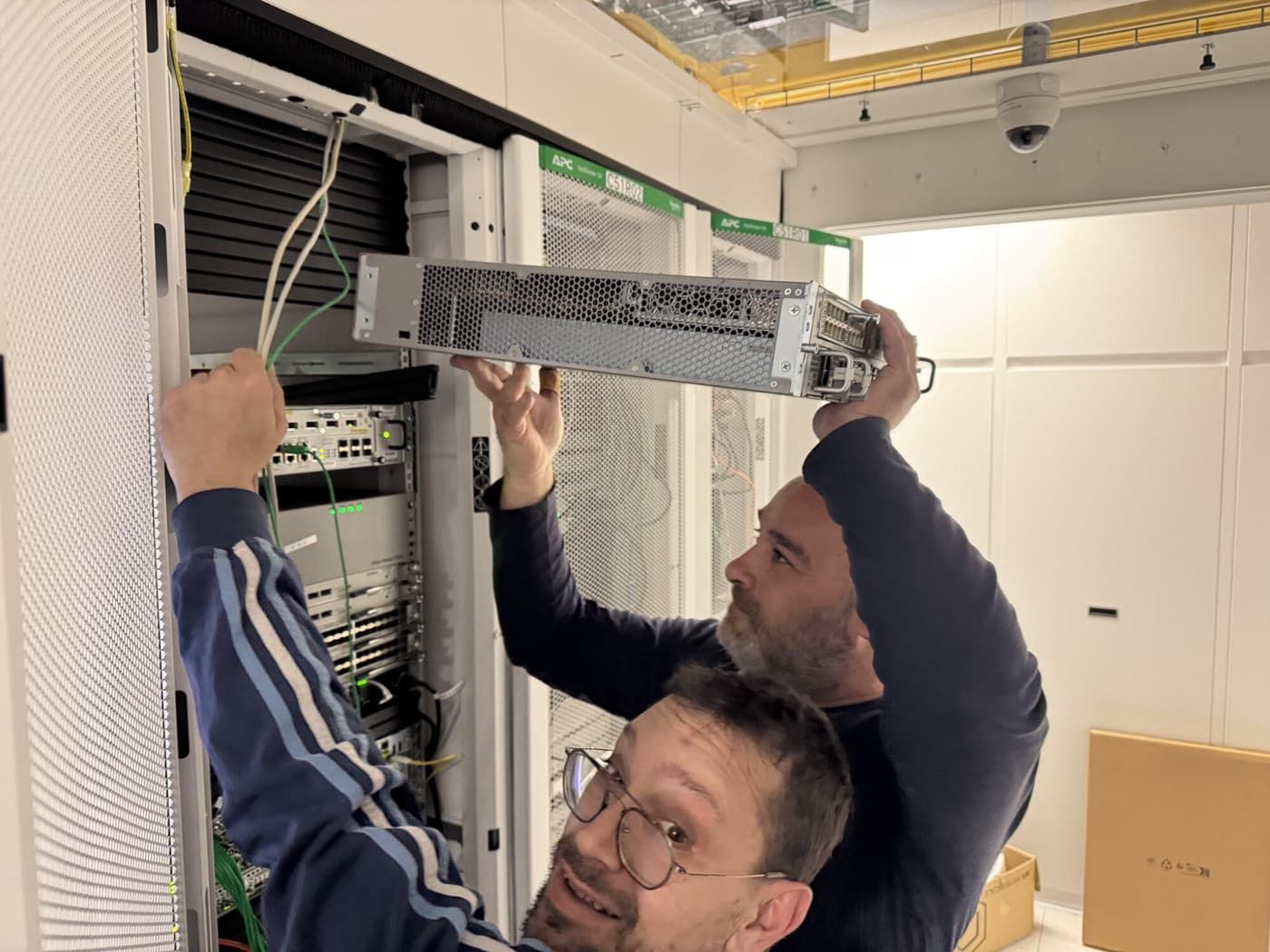
A server is not ready when it is screwed into a rack. It is ready when it is cabled and recorded, zoned on both storage fabrics, presented its storage, licensed for remote management, reachable on an isolated management network and verified at every step. We commission hardware the same way every time, from written runbooks, so every machine leaves the bench built to one standard.
What it is
The physical and logical commissioning of servers and blades: racking and cabling, fibre channel zoning on both fabrics, storage host and volume creation on HPE 3PAR, and configuration of every management controller, whether HPE iLO, Dell iDRAC or an HPE Onboard Administrator running a whole blade enclosure. It covers HPE and Dell rack servers and HPE blade systems, and ends with the server tracked end to end in our DCIM.
How we build it
Licensed management controllers, not bare IPMI. Every Dell server carries iDRAC Enterprise with Datacenter licensing. Every HPE server carries iLO Advanced. Every blade enclosure is run through its Onboard Administrator, itself a redundant pair. The licence is what unlocks the remote console and virtual media; an unlicensed controller is little more than a power switch.
An air-gapped management network. Each controller has its own physical port and its own cable to its own switching, on private address space that is never routed to or from any customer network and never announced to the internet. A customer machine, even a compromised one, cannot see a management controller at all. Engineers reach it only through our own VPN gateways and jump hosts.
Blade onboarding in a fixed sequence. New blades follow a written runbook, step by step:
- Enclosure pre-flight: bays, interconnects and firmware confirmed.
- Every fibre channel WWPN and network MAC read from the enclosure itself.
- Zoning generated for each fabric from that data, with consistent naming.
- One atomic zoning transaction per fabric on the Brocade switches, second fabric first, then the first.
- The storage host created on both arrays of the federated pair, so the server can follow its storage.
- Volumes created and exported to the new host.
Whole enclosures configured in one move. Management-controller settings (licence, administrative users, session timeouts, time sources, SNMP) are pushed through each Onboard Administrator across the enclosure backplane in a single operation. No per-blade credentials are needed, which means a blade racked this morning can be fully configured this afternoon.
Recorded and labelled. Every cable gets its unique printed ID at both ends, every port its link in DCIM, and every address its forward and reverse DNS, before the job is considered finished.
Every runbook has its proof. Each procedure lives next to the transcript of a successful run, so the next engineer repeats exactly what worked.
What it protects you from
- A server zoned on one storage fabric only, one switch failure away from losing its disks.
- Blades that never received their management licence and cannot be reached remotely.
- Management controllers sitting on a network customers can reach.
- A build only one person knows how to repeat.
- Hardware in the rack that the records do not know about.
In practice
New blades, zoned on both fabrics in minutes. Batches of new blades were onboarded end to end with about ninety seconds of switch time per batch: aliases and zones generated from the enclosure's own data, committed in one transaction per fabric, and verified, followed by storage hosts on both arrays and their volumes.
A whole rack of enclosures, licensed at once. When a rack of blade enclosures needed iLO Advanced licensing, a management account and session timeouts on every blade, we did not log in to a single blade. The settings were pushed through each Onboard Administrator, and the whole rack was finished in about thirty seconds end to end, including blades racked that week that had no credentials of their own yet.
Space when you need it. We hold reserved rack capacity in every facility as a baseline, at Digital Realty, and expand it as customer workload and power demand grow. When a customer needs new hardware, the space, the power and the switch ports are already there, and commissioning starts the day the hardware arrives.
Why EuroVPS
- Licensed iDRAC Enterprise and iLO Advanced on every server, not bare IPMI.
- An air-gapped management network that customer traffic cannot reach.
- Written, proven runbooks for every build step.
FAQ
Can I get remote console access to my dedicated server? By default our engineers use the remote console and act for you, around the clock. If you need direct iLO or iDRAC access, we can provide it at additional cost over a dedicated VPN, so the controller itself stays on the isolated management network.
How quickly can you add capacity? We keep reserved rack capacity in every facility, and commissioning is a runbook, so new hardware goes from delivery to production quickly. Talk to us about your timeline.
Do you use HPE or Dell? Both, chosen by the job, with licensed management on every machine.
If you want hardware commissioned to one standard every time, Talk to an engineer.
Your next infrastructure partner
Let’s look at
your setup.
Tell us what you run today and what needs to improve. An engineer will review your brief and help you plan the next step.
+357 222 32280
who will look after your infrastructure.
Let’s start with your setup.
A little context helps us start the right conversation.