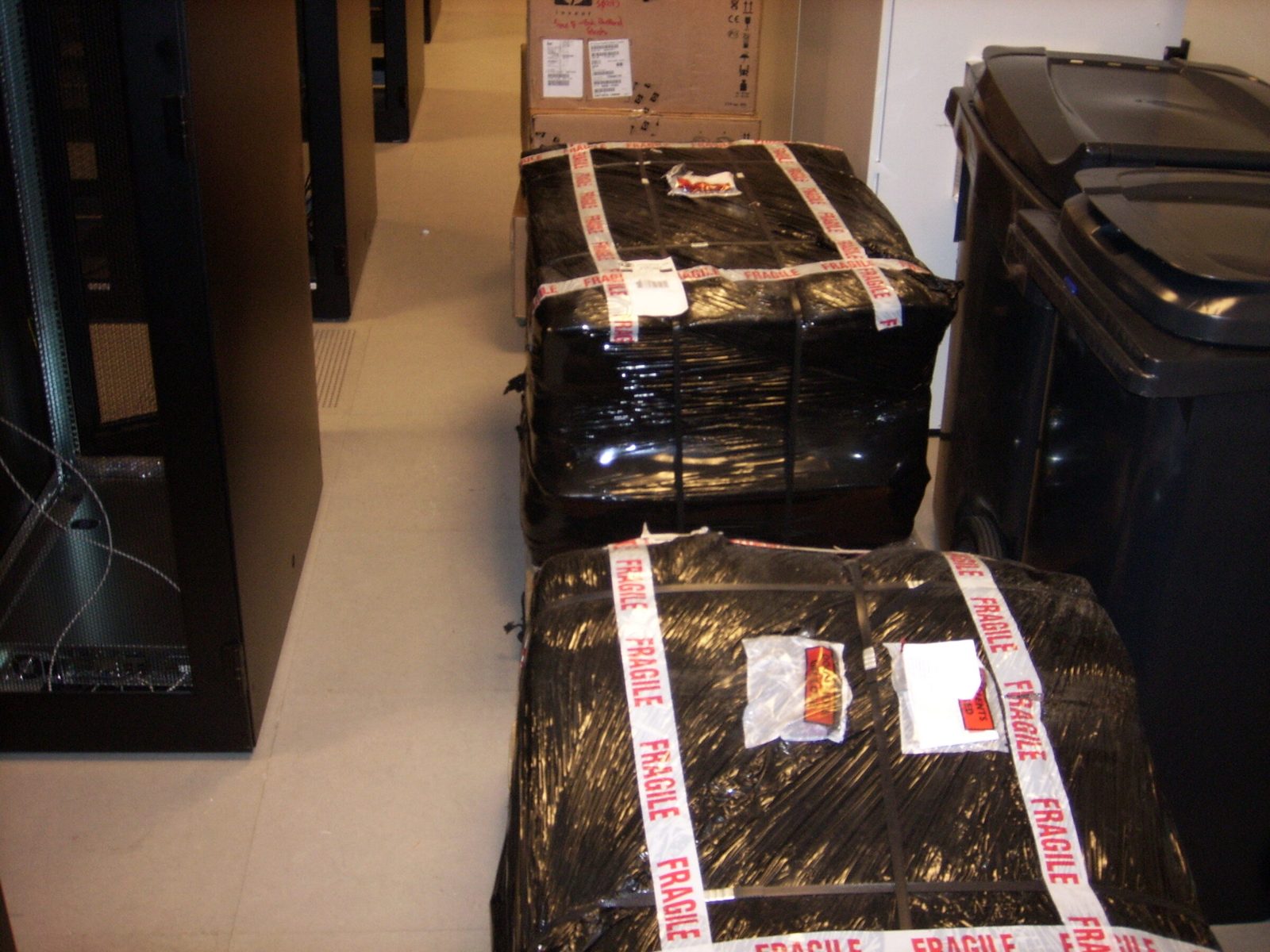
Spared no expense
The drives we refuse to buy, the boards we refuse to run, the networks that never touch, and why. How EuroVPS has been built since 2004.
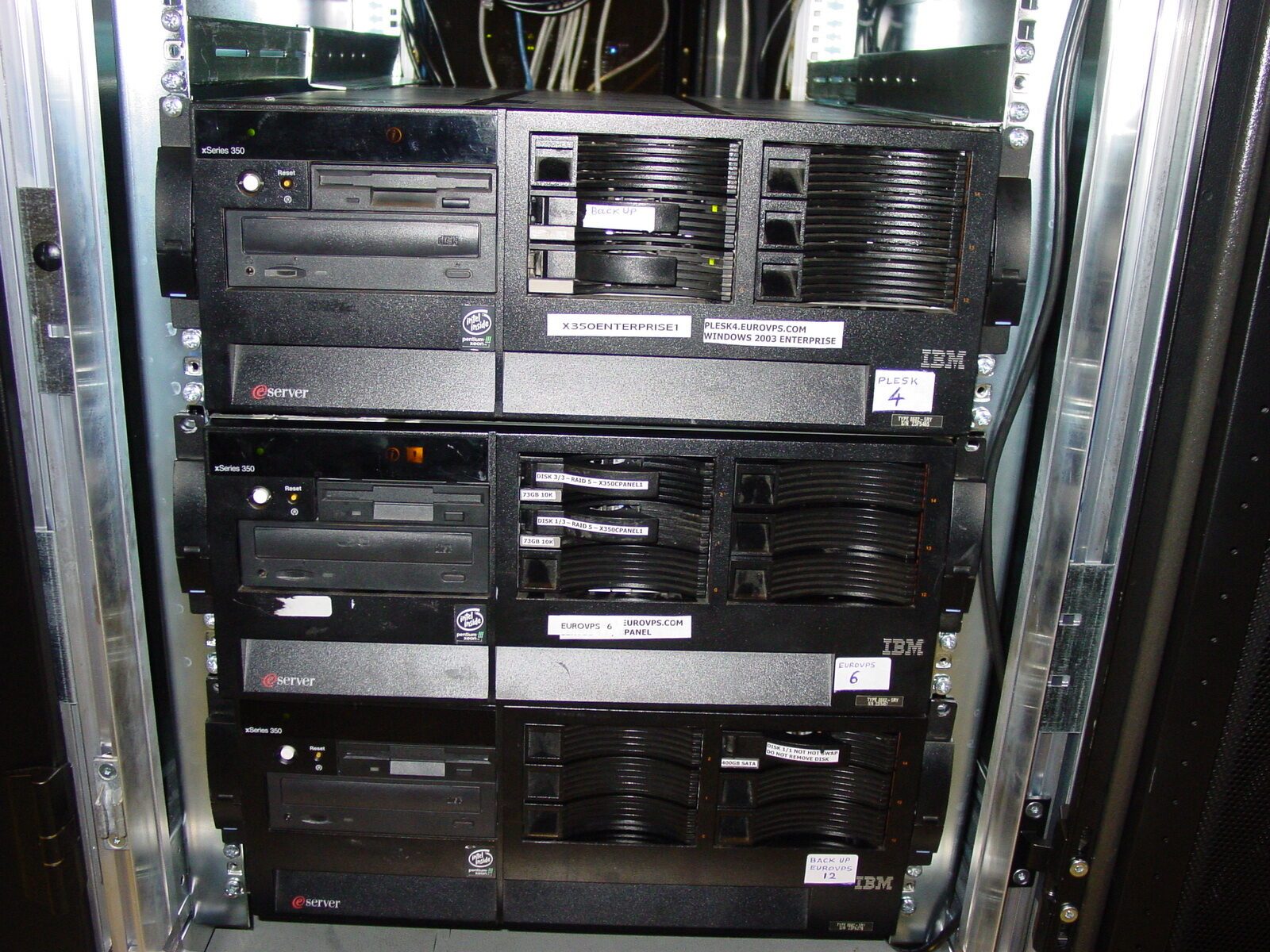
In 2004 EuroVPS was one machine. Not a cheap one.
It was an IBM xSeries 350: a four socket, enterprise class server, bought by a 21 year old with his father's help and carried by hand into a colocation hall in Amsterdam. The cheapest machine that would have done the job cost a fraction of what we paid. We bought the xSeries anyway, and the reason is the only company policy we have ever had: start with the best machine you can afford, not the cheapest one that works.
Plesk ran on it. The labels we printed for the front of that first stack are still legible in the photographs: the hostname on every machine, the RAID layout across the drive bays, and one chassis marked BACK UP. Two people with one server, already labelling drive bays, already running a separate machine for backups. Nothing about the way we work today is a later invention. It is the same habits, with more hardware.
The Amsterdam years
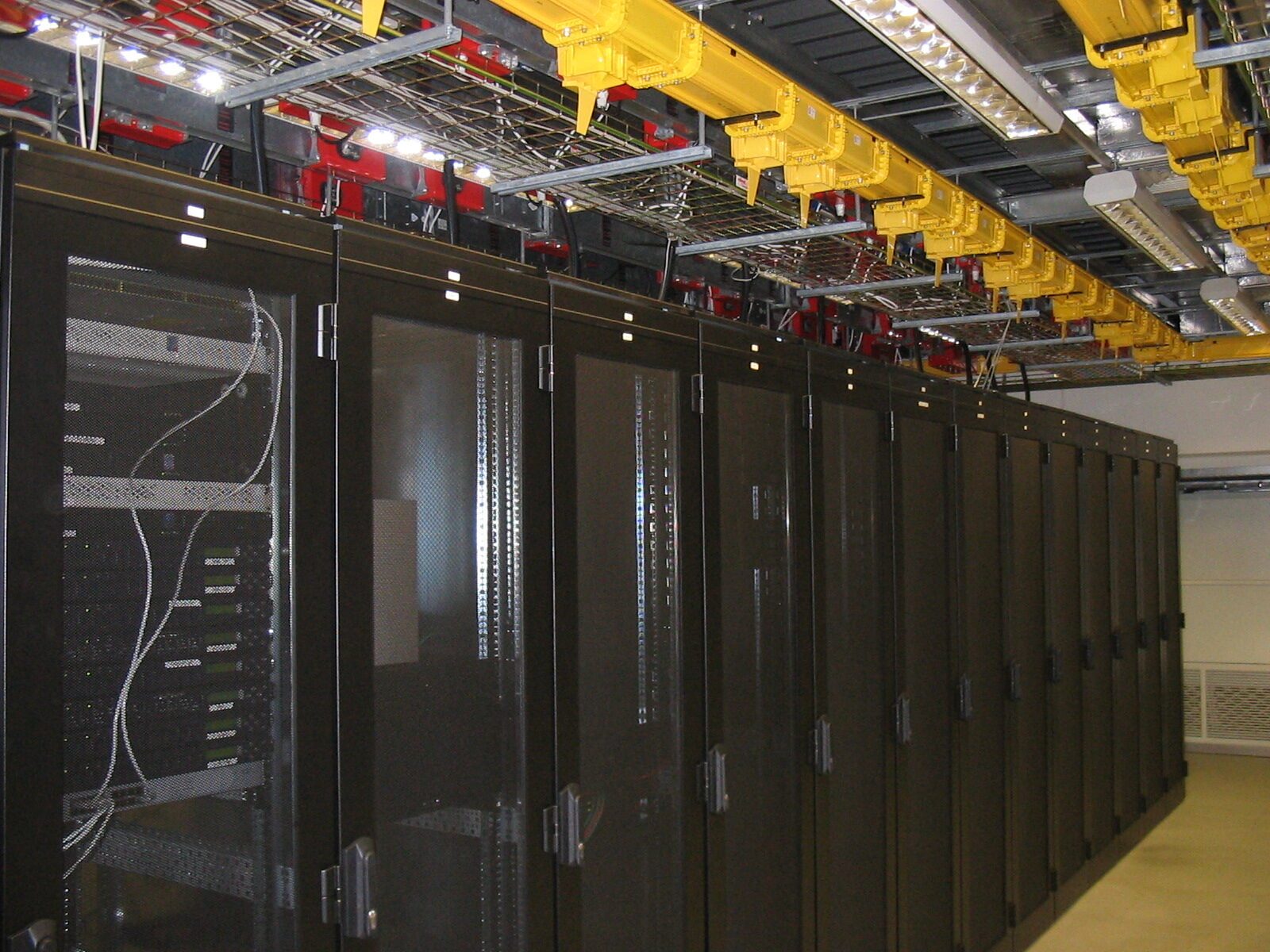
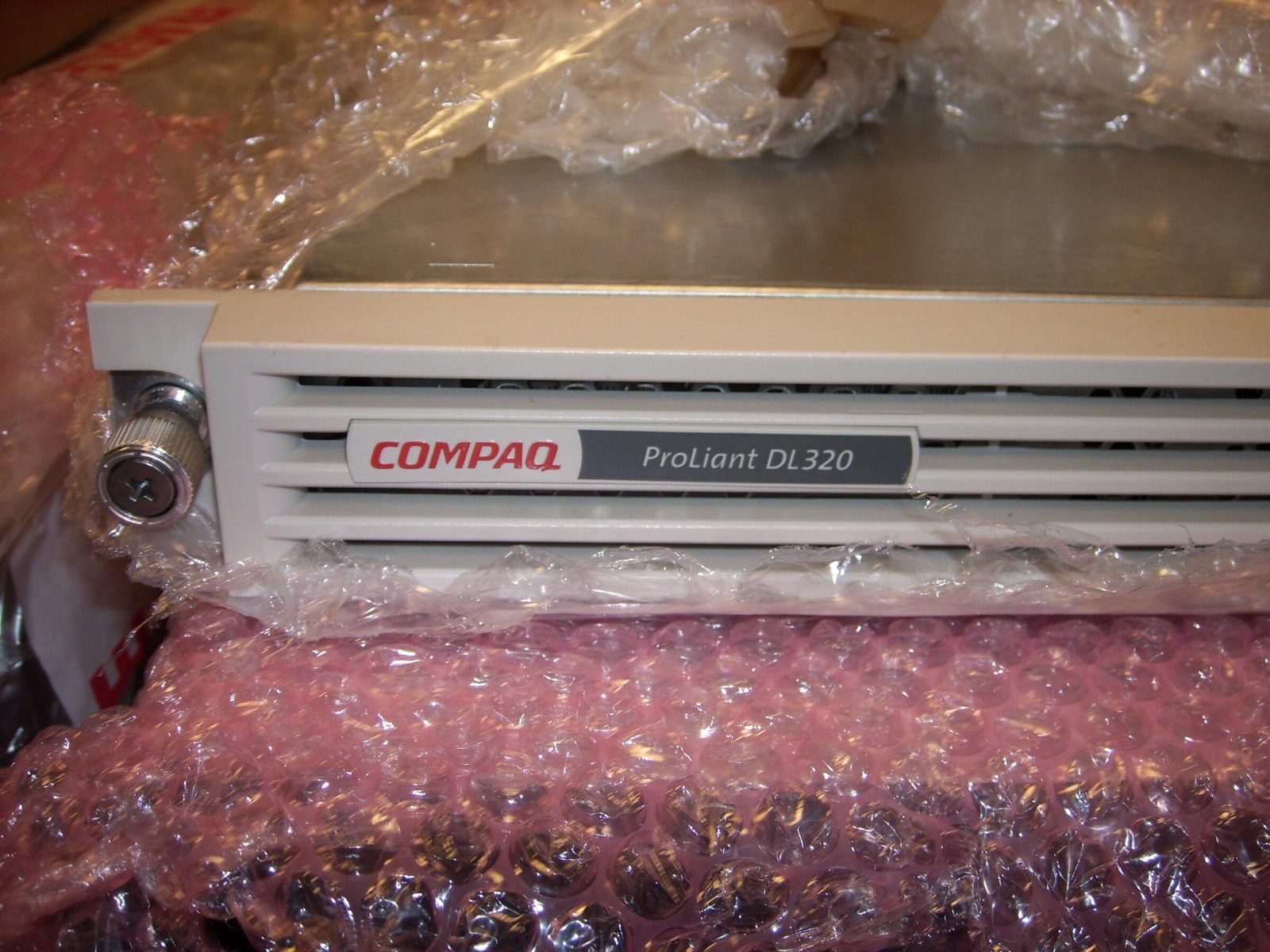
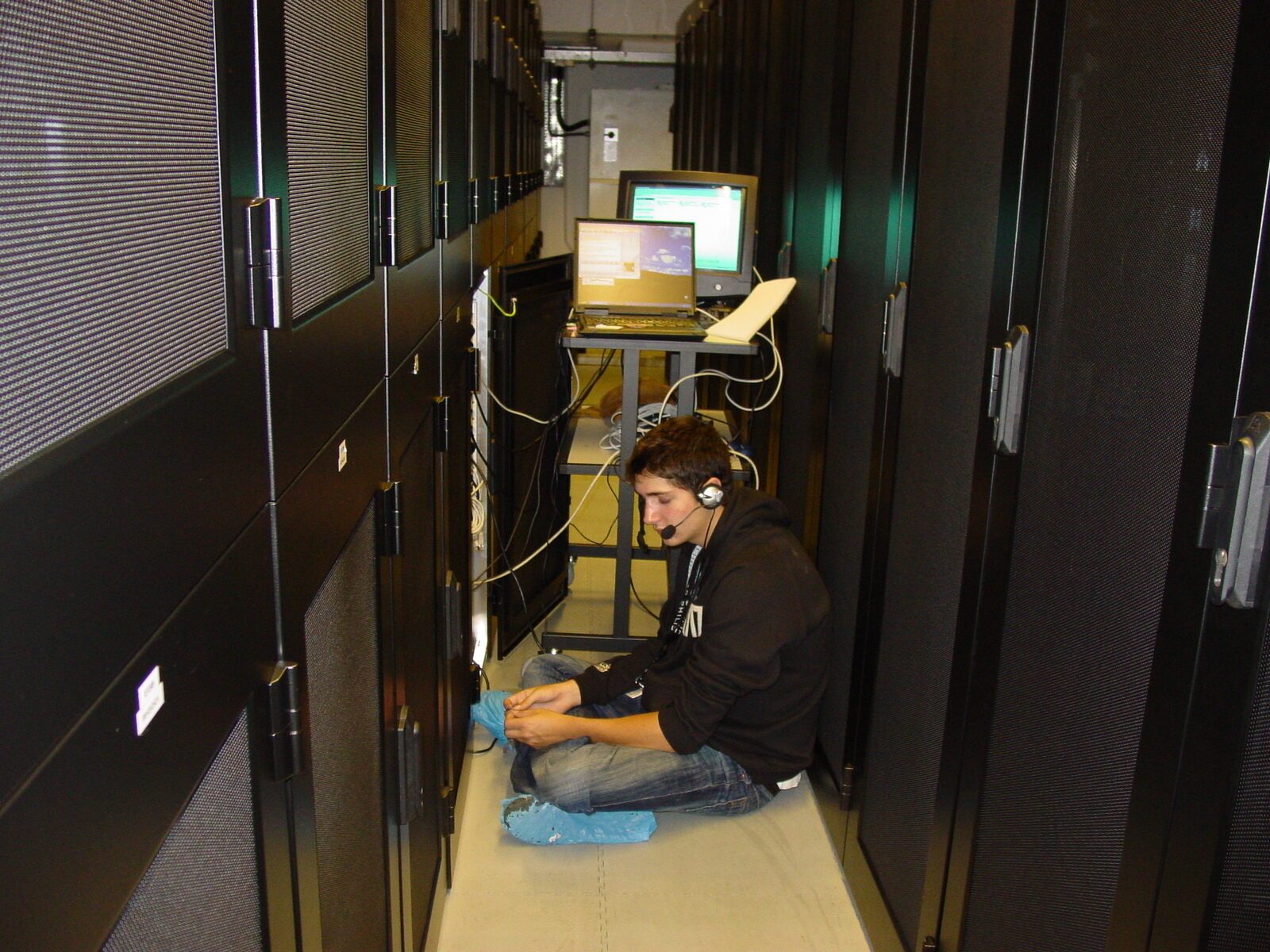
The early years were an aisle, a crash cart and a laptop on the floor. IBM xSeries first, then Compaq and HP ProLiant side by side for most of the decade, bought new and unpacked between the cabinets. Storage moved onto enterprise arrays early, EMC CLARiiON over dual Fibre Channel fabrics, with Cisco at the core, because we would rather pay for the second path than one day explain why there was not one. Blade chassis followed, then whole columns of them, and the estate grew into our own cages at Iron Mountain.
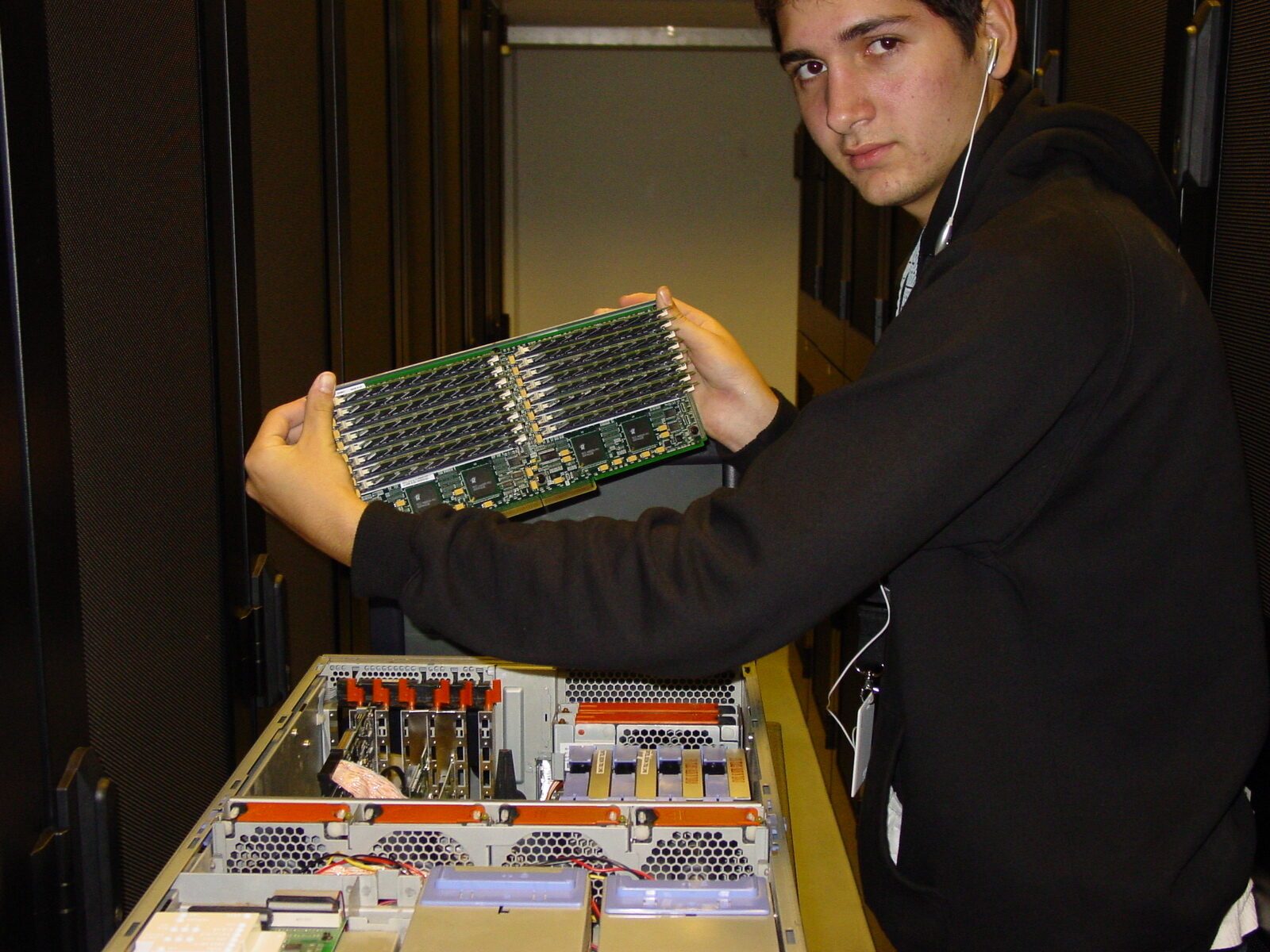
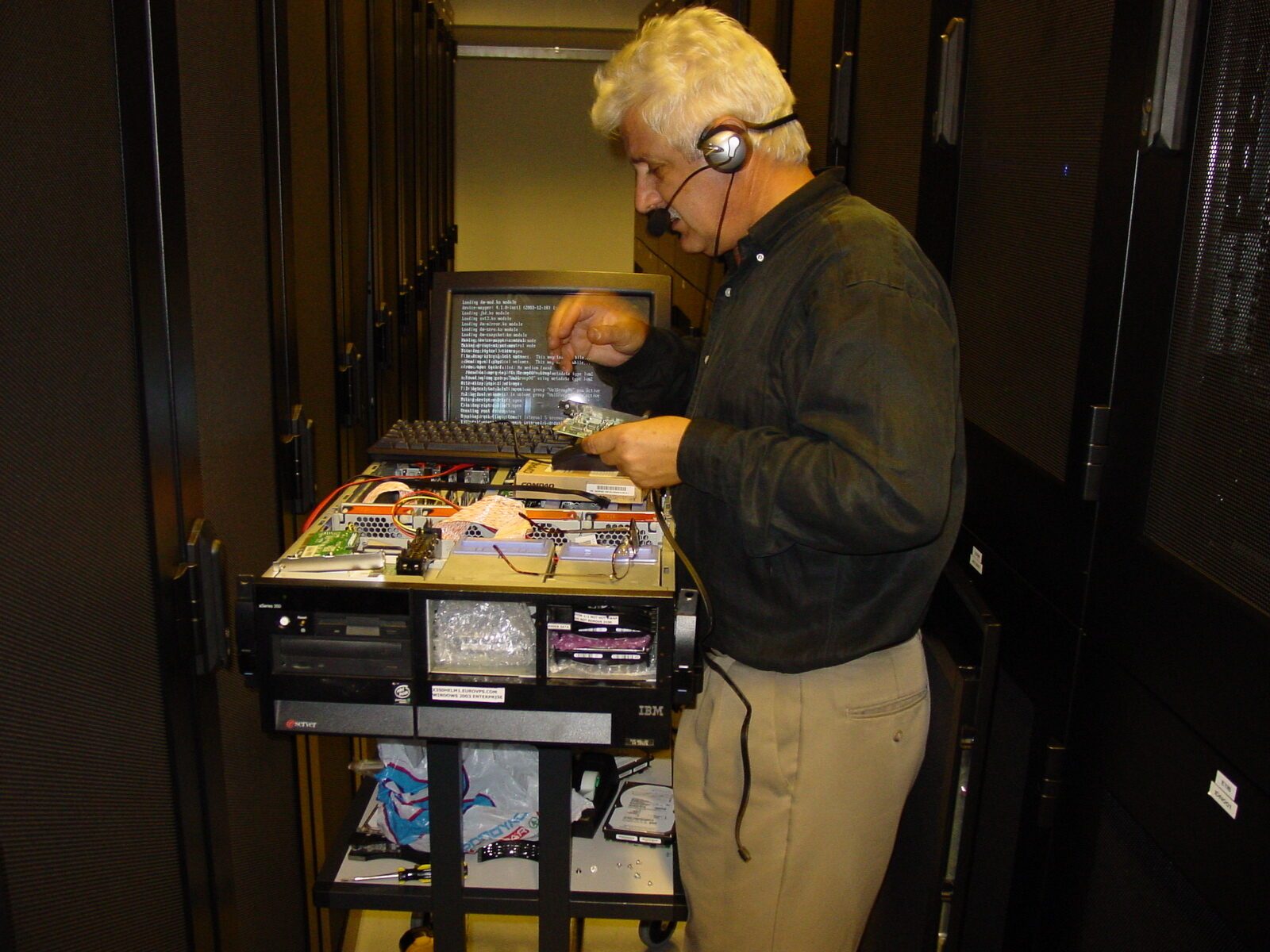
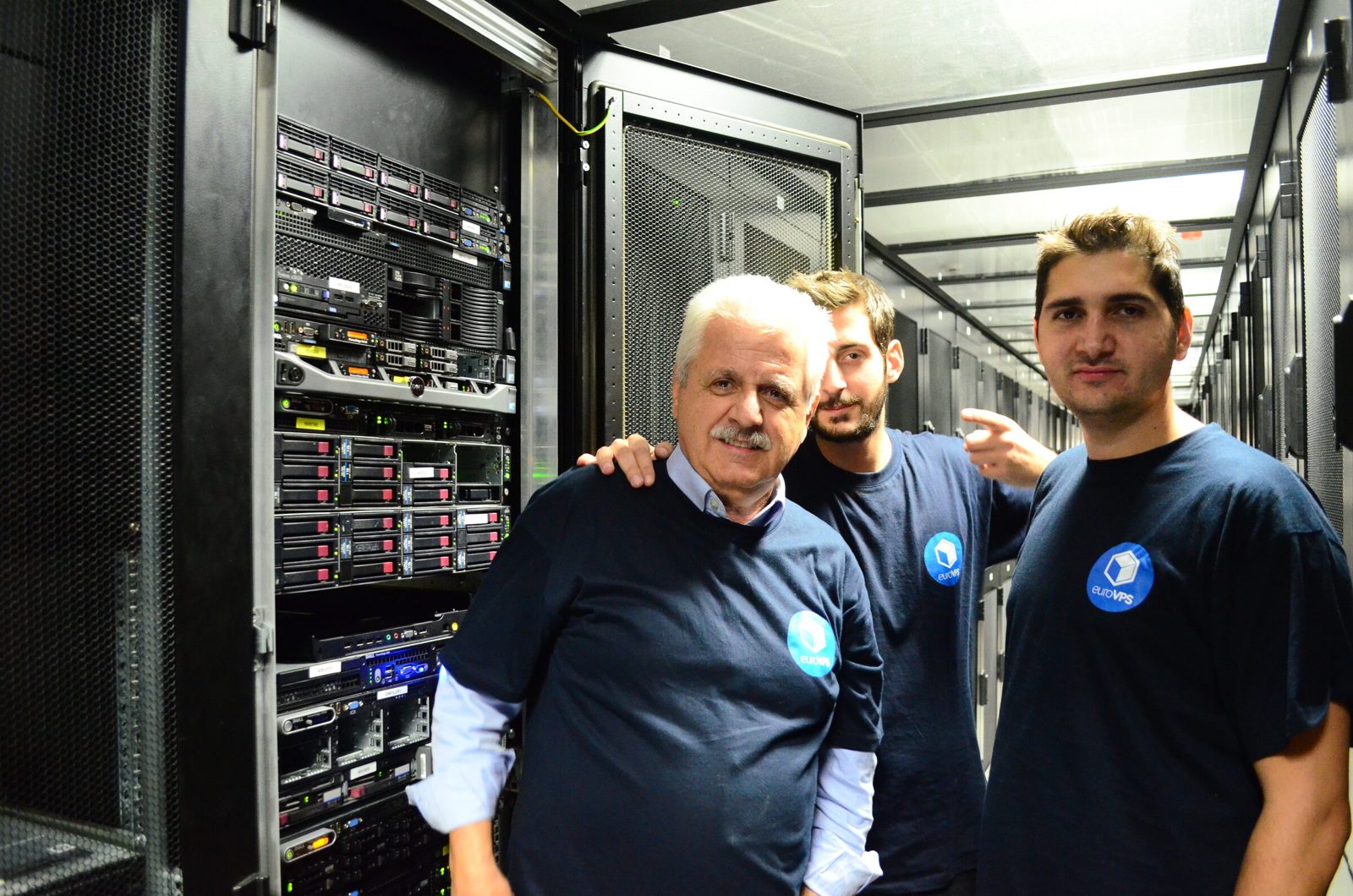
Three of us in the Amsterdam aisle in 2014, in company shirts. One of them is the father who was at the crash cart ten years earlier.
Athens, Amsterdam, Toronto
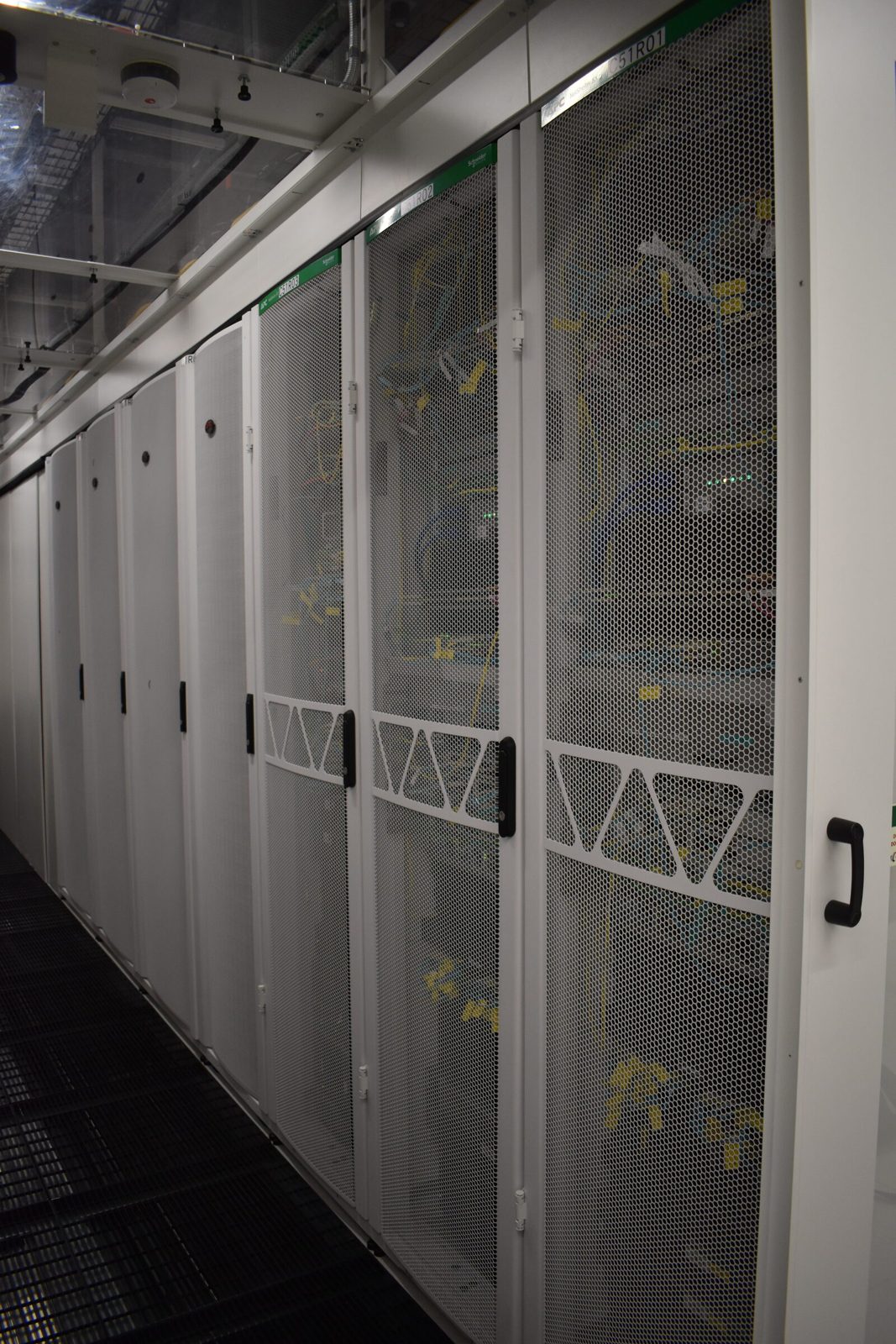
The flagship today is our own cage at Digital Realty Athens: our own routers, all flash storage, fibre to every port, built the way the first rack was built, by us. Amsterdam continues, joined to Athens over private Layer 2, so the two behave as one network and you can move between them without renumbering anything. Toronto covers North America from Cogent. Our management hub is in Cyprus.
Quality over profit
We come from an age before margin maximisation became the mantra.
EuroVPS has no venture capital, no outside funding, no loans and no exit plan. Nobody has ever told us to take a cost out of a platform to make a quarter look better, because there is no quarter to make and nobody to make it for. The company is owned by the people who built it, server by server, with their own hands.
That is not sentiment, it is a decision process. Every technical choice here is settled on engineering merit and on what it will cost us to be woken up, not on what it does to a margin. When a hosting company takes outside money it eventually has to give something back, and what gets given back is almost always the part you cannot see: the second power feed, the original optic, the spare on the shelf, the senior engineer at three in the morning. We kept all four, because the only shareholder here is the one who gets paged.
What we refuse to buy
We are a hosting company, so hardware is not a cost line we are trying to shrink. It is the product. Almost everything that makes cheap hosting cheap comes down to a short list of components, and none of them goes under a customer workload of ours.
SATA disks
One port, one path, one controller: a single point of failure by construction, and no software layer above it can invent a second route. SATA queues shallowly and recovers from errors badly, so a desktop class drive can sit retrying a weak sector while everything above it waits. Enterprise SAS is dual ported, reports its error counters honestly, and hands control back fast enough for the RAID layer to do its job.
SATA SSDs
Same single port, same shallow queue, on an interface built for spinning disks. Putting flash behind SATA means paying for the medium and then discarding most of what it offers. That market is also overwhelmingly a consumer one: low endurance, no second port, often no power loss protection.
Consumer M.2 NVMe sticks
M.2 is a laptop form factor bolted to a motherboard, not hot pluggable and not serviceable without powering the server down. Consumer sticks usually carry no power loss protection capacitors, so a write in flight when power goes away is a write you may never see again, and their endurance is specified for a desktop, not for a database that writes all day. We run plenty of NVMe, as enterprise U.2 and U.3 drives with power loss protection in hot plug carriers. Never as a stick glued to a board holding the only copy.
Single socket desktop class boards
One socket, one supply, no out of band management worth the name, and too few PCIe lanes to carry a dual port Fibre Channel HBA and redundant networking at once. There is no hot plug backplane either, so every component failure is a power down. The design says one thing: if this breaks, the service stays broken until somebody drives to it.
A single power supply
Power work happens: PDUs get replaced, breakers get tested, feeds get maintained. One supply turns scheduled datacenter work into a customer outage. Every production server we buy has at least two hot plug supplies on two independent feeds, so an entire side can go away and the workload never notices.
Non-ECC memory
Without ECC a flipped bit is silent, and it surfaces later as a corrupted database row or a panic nobody can explain. With ECC the memory controller corrects it, counts it and reports it, so the module is replaced long before it reaches customer data. We will not run a workload on memory that cannot tell us it is failing.
Software RAID as the resilience story, and white box servers
We do not rest customer data on one box's software RAID, with an unprotected write cache and parity rebuilt on the host CPU. Resilience belongs in the array and in redundant fabrics, where it survives losing the server entirely. White box gets the same answer: no firmware lifecycle, no spares on the shelf, nobody to call.
In practice. We take nothing on trust from a device name or a kernel default: we interrogate the RAID controller and the drives directly, by two independent paths, and tune on what each device actually reports.
What we buy instead
HPE ProLiant and Dell PowerEdge: DL380 and DL385 rackmounts, BladeSystem c7000 enclosures carrying BL460c blades, and PowerEdge R640, R740, R7525 and C6400 for dense compute. The same baseline on every one of them.
- Two hot plug power supplies on two independent feeds.
- ECC memory throughout, with correctable error counters watched.
- Hardware RAID with battery or flash backed write cache wherever a server keeps local disks, so a power event cannot cost an acknowledged write.
- Enterprise SAS 12G SSD and enterprise NVMe, placed where measurement says they belong.
- Out of band management on every box, on an isolated network.
Hosts that boot from the SAN and hold nothing
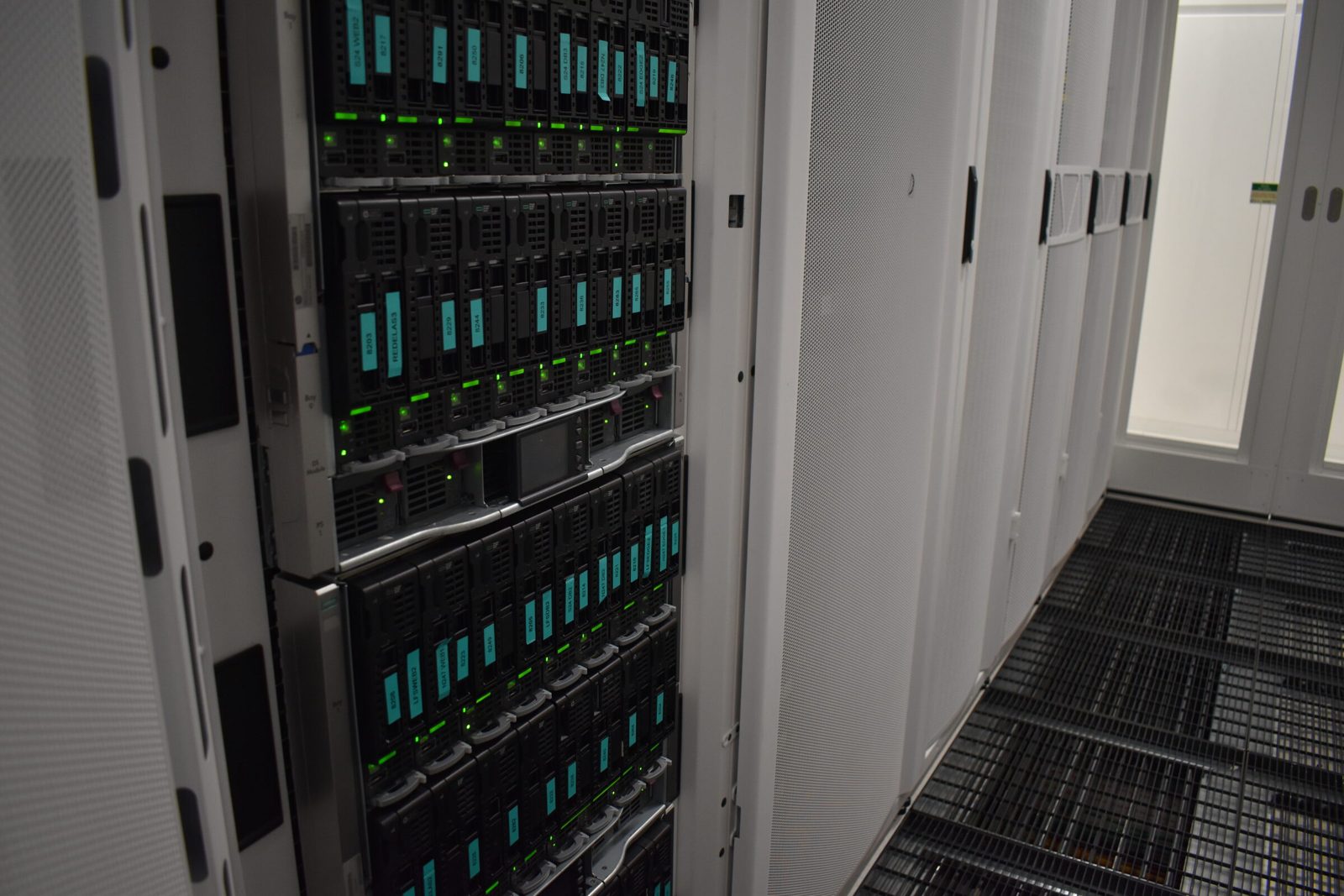
Our hypervisors boot from a volume on the array, presented over two physically separate Fibre Channel fabrics. The server itself holds no customer data, so a failed blade costs us a blade: the replacement boots the same volume. That is a parts swap, not a data recovery.
Machines that never cross a socket
House rule, and not negotiable: a virtual machine never gets more vCPU than one socket has physical cores, and never more memory than one NUMA node serves. Span two sockets and part of the memory traffic becomes remote, at roughly 1.7 times local latency, before the cache coherency traffic across the socket interconnect. The penalty compounds rather than averages out, which is why a machine sized past the socket boundary often runs slower than the smaller one it replaced.
Enterprise flash is not RAM
Our virtual machines get no swap. Swap on a VM pushes memory pressure down onto the array and spends flash write endurance that exists to serve real data. If an application needs more memory, the honest answer is more memory, or a fix in the application. We will tell you which.
Tuned, not shipped on defaults
Flash backed volumes get the right scheduler, read ahead and queue depth, not heuristics written for spinning disks. Bonded interfaces hash on addresses and ports rather than on MAC addresses alone, so every member of the bond genuinely carries traffic. Small, permanent wins, on every build.
In practice. A web tier that arrived sized past its socket boundary got faster, not slower, once it was resized to fit inside one socket. On a bonded server, hashing on addresses and ports took traffic distribution between the two members from almost entirely one sided to very close to even, for one line of configuration.
Storage: HPE 3PAR, all-flash, two of everything
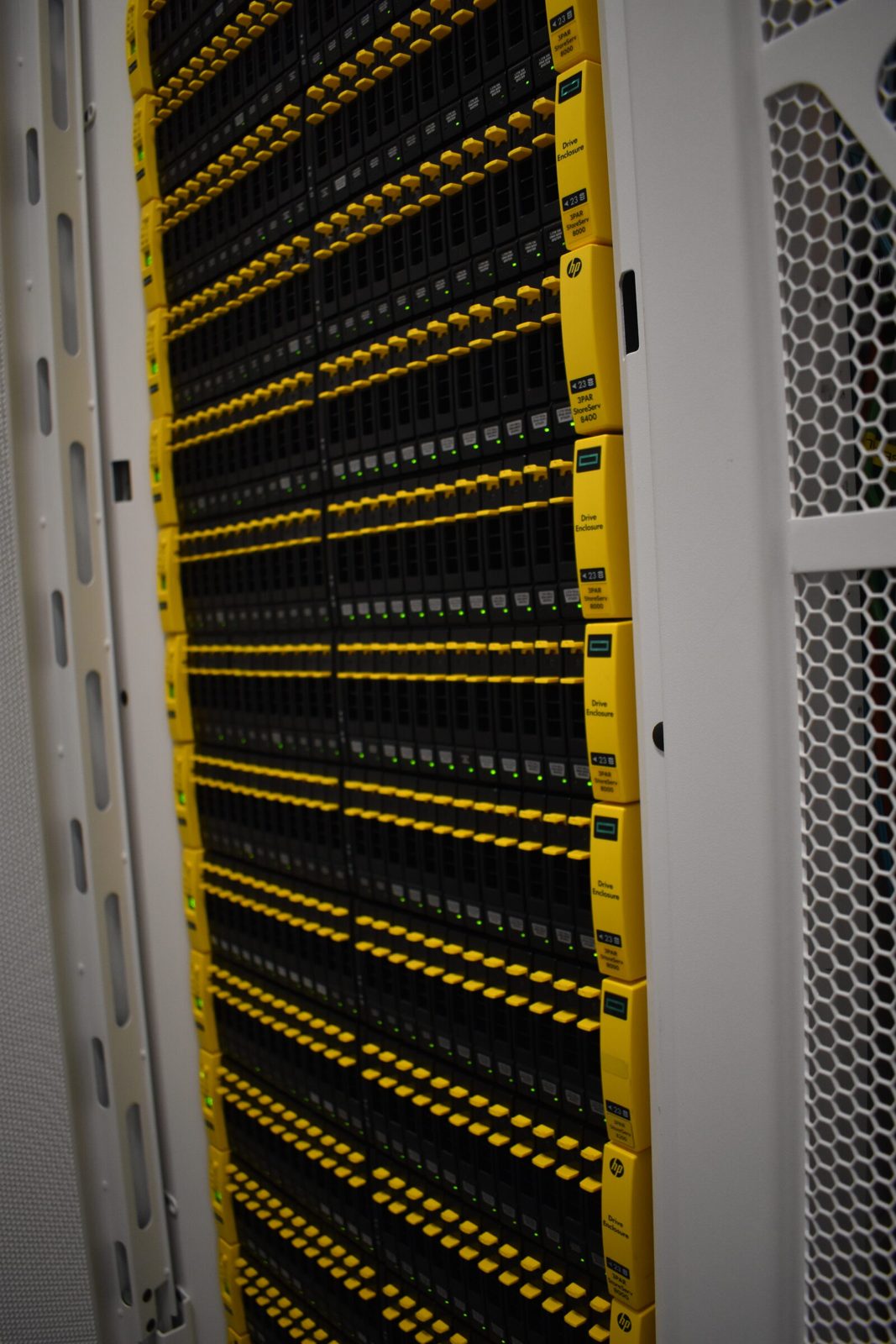
Customer data lives on HPE 3PAR, all-flash, in SSD RAID 6 provisioning groups. RAID 6 because the rebuild of a large flash drive is a window, and we will not spend it one failure away from data loss.
Two controllers, two fabrics, many paths
Dual controllers per array. Each host attaches through two physically separate Brocade Fibre Channel fabrics, one HBA port into each, and is registered with the correct persona so multipathing and ALUA behave as the operating system expects. A controller, a fabric, an optic or an HBA port can go away and the volume stays online.
Thin that tells the truth, volumes that move while in use
Volumes are thin with automatic zero detect, so a fully provisioned guest disk costs next to nothing physically until real data arrives. The arrays are federated, so we migrate a live volume from one array to another while the host keeps reading and writing to it. For clustered databases we go further and place each member on a different physical array, so losing a whole array costs one replica and quorum holds.
Drive hygiene, and discipline on writes
A drive reporting a corrected error is a drive whose internal error correction is already working, under live customer traffic. We do not wait for it to fail: it is drained to zero, dismissed, replaced with a clean drive, and the array admits the new one automatically. Every write command against a shared array is written out, reviewed and approved before it runs. Read only inspection is free and constant; anything that writes is deliberate.
Backups pull, and recovery matches the service
Backups are pull only. The protected systems have no route to the backup infrastructure and no credentials for it, so a compromise on the production side cannot reach the backups. The secure side reaches out and takes what it needs, never the reverse. Recovery objectives are set per service, not as one house number: a static site and a transactional database do not deserve the same answer.
In practice. In one planned pass across the Athens arrays, every drive carrying a non zero corrected error counter was drained to zero, pulled, and replaced with a clean one, each replacement admitted automatically. Customer workload ran throughout, with zero impact and no window.
A customer can migrate their storage, replace their servers and rewrite their software. What they cannot change afterwards is the cabling, the optics and the routers.
Fibre end to end
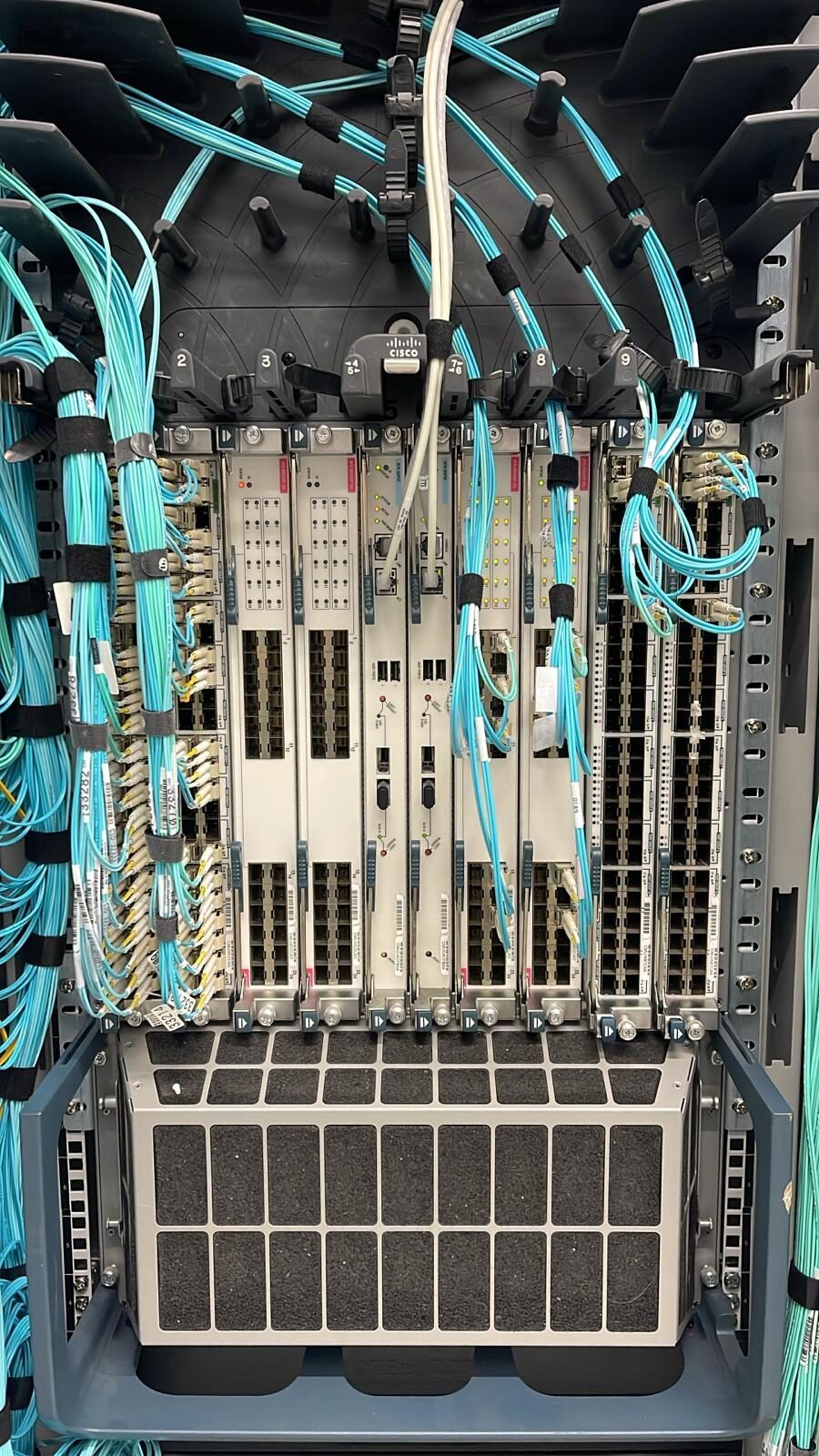
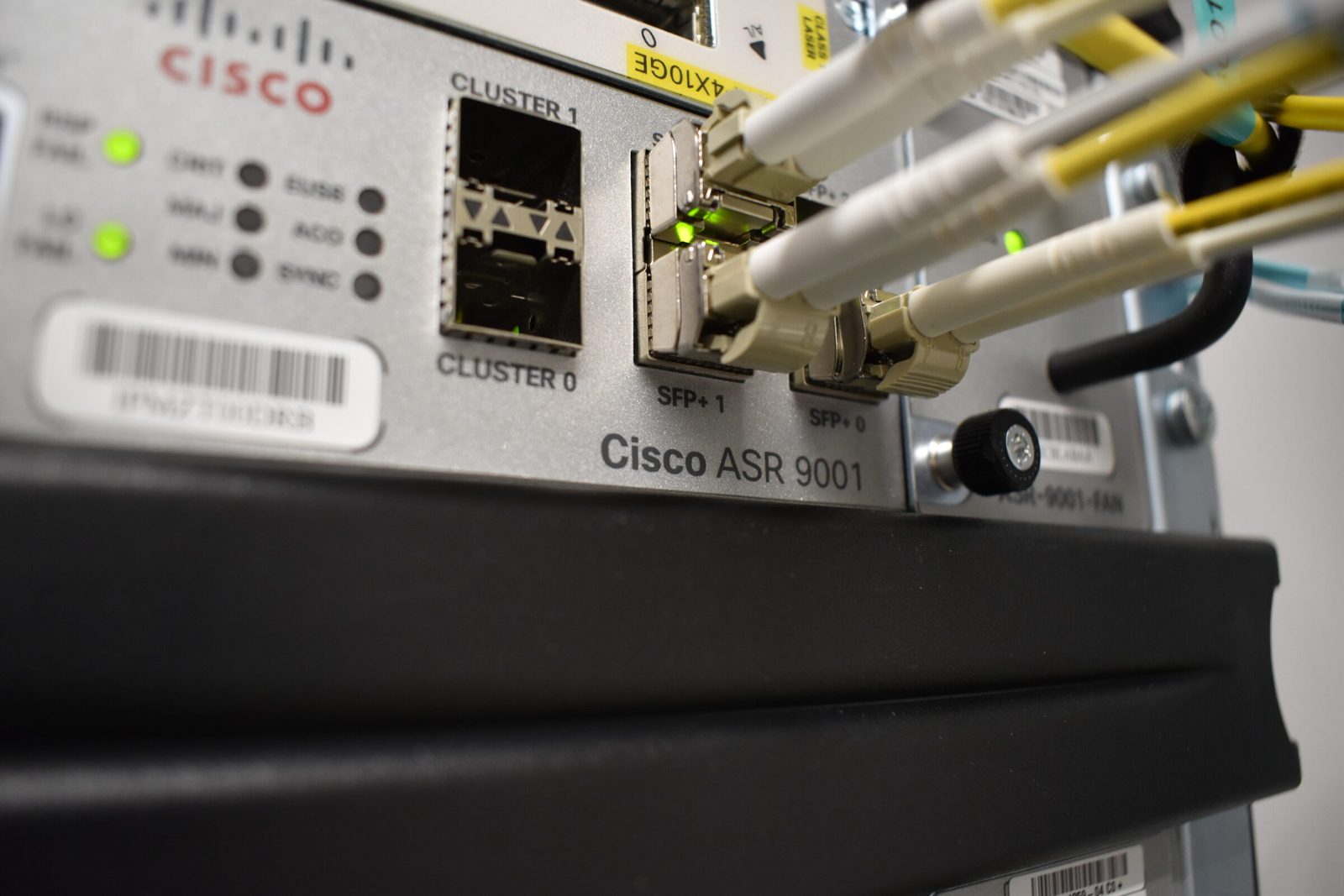
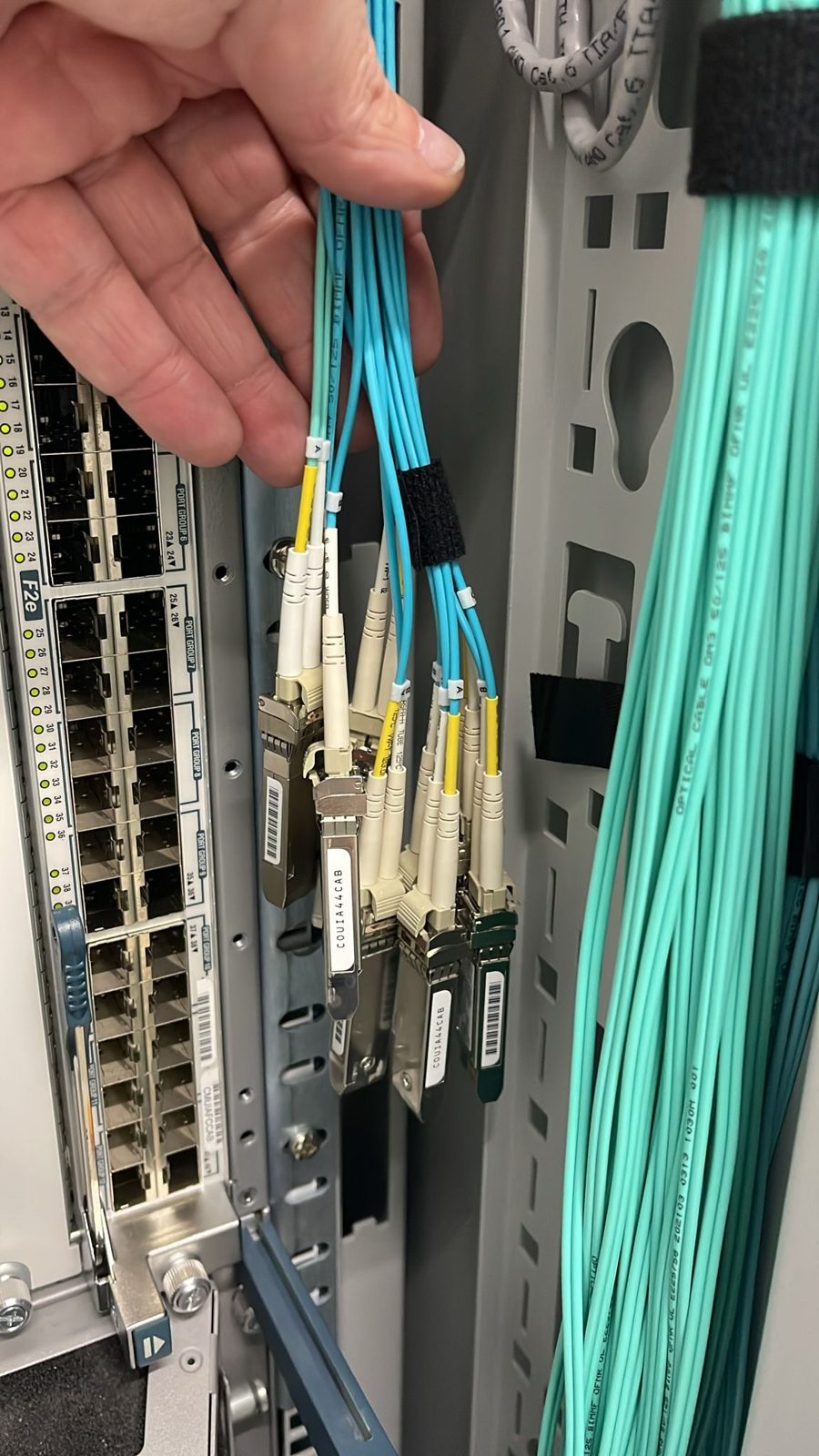
There is no copper data cabling in our datacenters. Every server, every blade chassis, every storage array, every switch and every router is connected over optical fibre. The only copper left in a cabinet is the short run to a server's lights-out management port, and that is deliberate: it is the one interface whose job is to work when everything else is off.
Glass wins on every axis that matters in a cabinet. An optical link does not care about electrical noise or the power whip lying beside it, so a link is either right or absent, never mysteriously marginal, and a run crosses the rack, the row and the hall at the same specification. High-speed copper is thick, heavy and reluctant to bend, and that mass ends up hanging off the switch it serves, in front of its exhaust; fibre is thin and light, so cabinets stay clean. And when the next generation of speeds arrives, the plant stays where it is: we change the transceiver at each end and keep the cable.
In practice. Ahead of launching new customer platforms we built a blade rack's entire fibre and port-channel topology before most of the blades existed. Launch day was a power-on, not a cabling job.
Original optics only
Every SFP, SFP+ and QSFP in our racks is the manufacturer's own part, matched to the switch or router it sits in and supported by the vendor whose name is on the chassis. We have never bought a generic transceiver and we are not going to start.
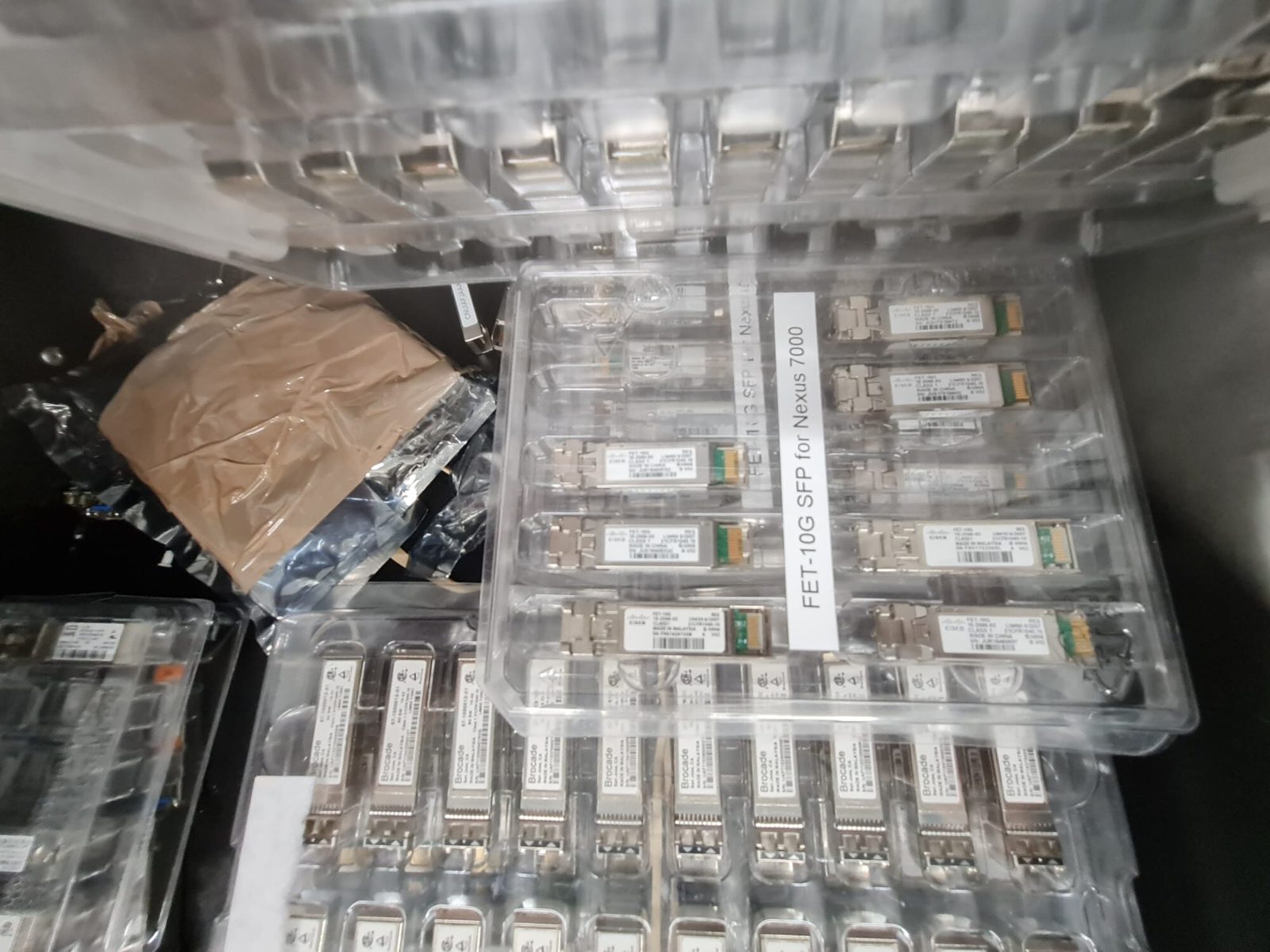
The saving is small and it buys four problems: optical readings that may mean nothing, costing you the best diagnostic on an optical network, the live light level at each end; a module that works on one software release and misbehaves on the next, because nobody tested that combination; a legitimate reason for a vendor to close the support case you open on the night you need it most; and a link that flaps under load for reasons nobody can reproduce. So we buy the right part, and we buy spares: trays of optics on the shelf inside the datacenter, so a replacement is a walk down the aisle instead of a purchase order.
In practice. Our routine health sweeps read interface and optical error counters across the fabric, and because every module is the vendor's own, what they report can be acted on: a transceiver drifting out of specification is a planned swap from the tray, on our clock.
The fabric: leaf and spine, EVPN and VXLAN
Inside the datacenter everything hangs off a Cisco Nexus 9000 leaf and spine fabric running BGP EVPN with VXLAN. The spines are pure route reflectors, with no tunnel endpoints on them by design. Leaves are built as virtual port-channel pairs, so every host is dual-homed to two switches through one logical bond, and a customer subnet's gateway is the same anycast address on every leaf. Broadcast traffic is replicated by BGP rather than by a multicast tree, and BFD runs where fast detection matters. Because any VLAN can live on any leaf, we can extend a customer's Layer 2 between our datacenters and let their servers keep their addresses while they move.
Every Layer 2 segment's network identifier is derived from its local VLAN by a fixed rule, and that rule is not a convention in a document. An automated check reads the map from every leaf, confirms the leaves are identical and obey the rule, and compares a cryptographic fingerprint of the whole map against a signed baseline in version control. It runs before any change is saved and on a schedule afterwards, drift pages an engineer, and an intended change has to be re-signed, so every fabric change carries an author and an audit trail.
In practice. In a controlled failure test we rebooted a cluster node while it was the preferred path for a live public address. The fabric converged onto a healthy node in about three seconds; the cluster's own orchestration did not mark that node down until nearly a minute later, and the address never left the routing table.
The edge: our own autonomous systems
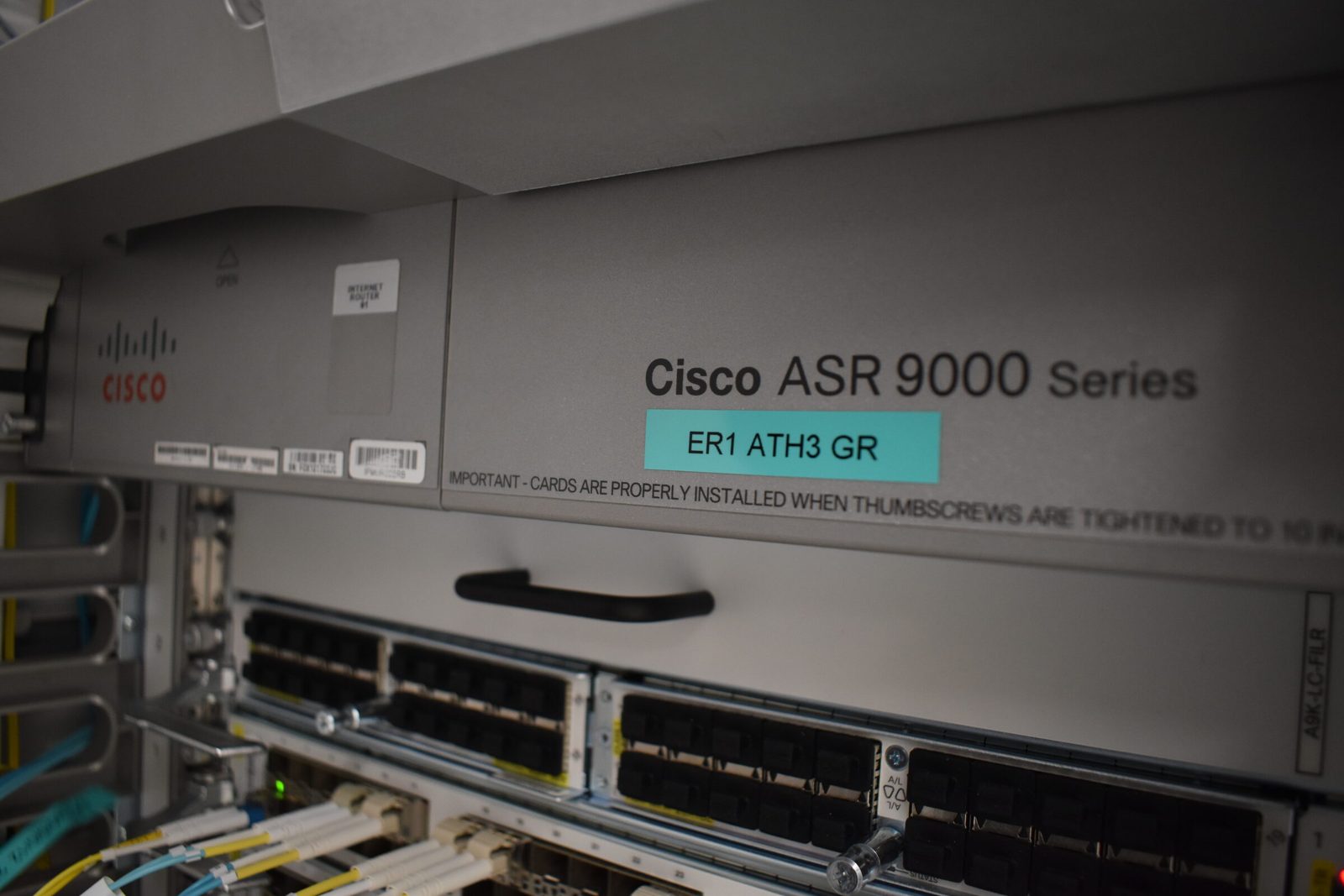
We run our own internet edge, on our own autonomous systems registered with RIPE and our own IPv4 and IPv6 space, with customer production and platform services on separate autonomous systems so a problem on one cannot reach the other. The routers are carrier-class: Cisco ASR 9000 series in Athens, an ASR 9006 at the front of the production edge, and Juniper MX204 in Amsterdam, each holding the full internet routing table and exchanging it with its sibling.
We buy transit from several carriers rather than renting a port from whoever owns the building: OTE Globe, Cogent and Hurricane Electric in Athens, Arelion, NTT, Deutsche Telekom and Telecom Italia on the Amsterdam side, with the two sites joined over private Layer 2 so the estate behaves as one network. We peer directly at GR-IX and NetIX, and add bilateral sessions one at a time with the networks our customers actually talk to.
Inbound sessions drop bogons, our own prefixes and anything longer than a /24. Outbound policy announces only what we originate. BCP38 anti-spoof filtering is bound to every internet-facing interface, and we publish RPKI Route Origin Authorizations for every block we originate, so the rest of the internet can verify cryptographically that a route claiming to be ours is ours. IPv6 is native throughout: dual-stack from the edge routers through the fabric to the customer gateway, with no tunnel and no translation in the path.
In practice. Our Athens fabric went dual-stack in a single working day, from the internet edge through the fabric to a live shared customer VLAN, with zero customer impact and no unplanned routing session resets. A later policy change moved traffic between Athens and Amsterdam onto a direct optical path, about 8.5 ms and ten hops shorter.
Fibre Channel: two fabrics, never one path
The network between servers and storage is Fibre Channel, not Ethernet, built as two completely independent Brocade fabrics. Every server and every array is connected to both, each fabric with its own core switching and its own switch inside each blade enclosure, so no single switch, cable, port or software fault exists on both sides of a host's path. Hosts multipath across all of it, which is what lets a controller, a switch, an optic or a cable be taken out of service while production runs.
Zoning is single-initiator and alias-based, generated from the host's real port identities and applied as one transaction per fabric. We commit on one fabric, verify it, and only then touch the other, so a zoning mistake cannot reach both paths of a host.
In practice. Because every host already holds live paths to every array in its federation across both fabrics, we can empty an entire storage array, for maintenance or a move, without rebooting a customer machine and without a maintenance window.
The encrypted backbone between our sites
Our datacenters in Athens, Amsterdam and Toronto, our management hub in Cyprus and our regional points of presence are joined by a Cisco DMVPN overlay: multipoint GRE tunnels protected by IPsec with AES-256, authenticated NHRP, BFD, and BGP over the tunnels. Every datacenter has redundant hubs, and because the overlay is routed by BGP rather than by static tables, losing a hub or a circuit is a route withdrawal that converges on its own.
A site with two WAN circuits runs a second DMVPN cloud on the same router, so the second circuit needs no new public address and no change at the hubs, and BGP multipath spreads traffic across both with a forwarding hash that includes ports so parallel flows genuinely split. We size against what the encryption engine can really do, about 11 Gbit/s per hub, not against the number printed on a licence, and scale with equal-cost multipath across hubs to 30 to 40 Gbit/s when a customer needs it.
In practice. On a dual-circuit site, a throughput test measured more in each direction than either circuit could carry on its own. That is the only acceptable proof that equal-cost multipath is working rather than merely configured.
The discipline that comes with it
Bonds that use both links. The Linux bonding default hashes on MAC addresses, which in a datacenter piles flows onto one member of a bond and leaves the other idle. Every bonded server we build hashes on layer 3 and layer 4, with the switch side set to match. On one production rack that single line took measured throughput from roughly half the installed capability to both members at line rate, so we make it a standard.
Every cable carries a unique printed ID. Numbers come from one allocator that reads the live inventory, its change history and every label ever printed, then issues them monotonically, so nothing is ever reused. Our tooling refuses to write an unreserved ID and fails closed if the allocator cannot be reached.
Every port recorded. Not a name on a row: the port with its real MAC address, the link to the far-end switch port with its cable ID, the rack position, the addresses and the management interface. The live device is the source of truth and the records are made to match it.
A reverse record for every address. Every address we assign to an interface, a loopback, a service or a host gets a PTR in our own authoritative DNS, in the same session. A traceroute through our network reads as a sentence naming the device, its role and its site.
The management plane, and the air gap
We do not use IPMI. Customer traffic and management traffic share nothing: not a port, not a switch, not an address, not a route.
There is exactly one copper cable left in our cabinets: the management port of each server's lights-out controller. It is also the most carefully isolated cable in the building.
Out-of-band management on every machine
We do not use IPMI.
Every Dell server we run carries iDRAC Enterprise with Datacenter licensing. Every HPE server carries iLO Advanced. Every blade chassis is run through its Onboard Administrator. These are licensed, paid-for management controllers, not the stripped IPMI port that comes free on a white-box machine. The difference is the difference between a server we can operate and a server somebody has to go and visit.
A lights-out controller is a computer in its own right, with its own processor, firmware, network port and power path, depending on none of the operating system, the kernel, the production network cards or the disks. A host at a kernel panic, half-booted, sitting in its firmware with no operating system at all, or switched off entirely, is still reachable and still reporting. From it we get a full remote console, virtual media so a machine can be rebuilt from nothing across the network, power control, firmware and BIOS management, and every hardware sensor. On the blade chassis the Onboard Administrator reaches every controller in the enclosure across the backplane, and is itself a redundant pair with automatic failover.
In practice. When a rack of blade chassis needed iLO Advanced licensed, and a management account created on every blade in it, we did not log in to a single blade. We pushed it through each chassis's Onboard Administrator and the rack was finished in minutes, including blades racked that week that had no credentials of their own yet. It is a runbook.
The management network is not the production network
Customer traffic and management traffic share nothing in our datacenters. Not a port, not a switch, not an address, not a route.
The controller has its own physical port and its own cable to its own switching. We do not partition a production network card and let the controller borrow a slice of it, which is the usual shortcut and the usual reason management ends up one mistake away from the internet. Management lives on its own switches, or on its own VLANs on fabrics that carry nothing else, in private address space that is not routed to or from any customer network and is never announced to the internet.
We call it an air gap because that is how it behaves. A customer virtual machine, even one fully compromised, scanning at line rate for a week, cannot see an iLO or an iDRAC at all. Not refused, not filtered: absent. There is nowhere for the packets to go. It holds in the other direction too, and that matters just as much: no management traffic rides a customer VLAN, so our console sessions, monitoring and backups never enter a customer's broadcast domain or compete for their bandwidth. The isolation is real enough to be inconvenient to us, which is the proof that it is real: a controller on a management VLAN cannot casually reach an internal web server to pull a firmware image, because nothing is permitted that was not asked for and written down. The engineer takes the extra step.
In practice. One canonical management access list is bound on every platform we run, on Cisco Nexus login lines, per routing instance on the routers, per interface for SSH and HTTPS on the firewalls, permitting only named management subnets, with control plane policing rate-limiting whatever is left in hardware. Then we check it the way an attacker would, not the way a documentation review would: from outside our own network, scanning our own public address space, confirming nothing answers.
The management plane itself
The management plane is a network in its own right and we built it like one. It runs on our own encrypted multi-site backbone: Cisco DMVPN, IPsec at AES-256, BGP carried over the tunnels, joining Athens, Amsterdam and Toronto to a management hub in Cyprus that is deliberately not in any of the buildings it manages. The hubs are redundant, with equal-cost paths across them and across diverse circuits, and failure detection that notices a dead path in well under a second.
Staff reach it one way: through VPN gateways and firewalls we own and operate ourselves, on OPNsense and Cisco Firepower, then through jump hosts inside the plane rather than straight from an engineer's laptop. Different trust tiers never share a firewall object, so widening one group's access cannot silently widen another's. When we work on a firewall we keep an independent out-of-band path into that site, because an engineer changing a firewall will cut off their own access at least once.
Toward the backup and disaster recovery planes the policy is deny by default and the data flows one way. Production never pushes to backup. The backup side pulls. That is enforced with explicit deny rules on the firewall appliances, not with a host firewall a compromised host could edit, and the backup segments have no route to the internet at all. Only the management range reaches them. If a production machine is taken over completely, the attacker gains no knowledge of the backup infrastructure and no path to it. From where they are standing, it does not exist.
Changes follow a fixed discipline. Every configuration is backed up before it is touched, to the device and to disk, and the backup is checked before we proceed. One command at a time, verified live against the running system rather than by re-reading what we just applied, with a stated one-step rollback. On a redundant pair, one half at a time, sessions confirmed back up before the other is touched. That is why we can work on the backbone in the middle of a working day.
In practice. We moved a customer's entire site-to-site VPN estate from one country to another in a single session, ahead of a fixed deadline. The hub was cloned, carried across and brought up in parallel with the original, so both were live at once and there was always somewhere for the tunnels to be. The branch routers were moved across one at a time, each verified up before the next was touched, each failing over cleanly as it went. Nobody travelled to a branch office.
The hardening baseline on every host
Every machine we build starts from the same baseline, and the baseline is not up for negotiation. SELinux is enforcing, and we do not switch it off to make an application cooperate, we write the policy instead. Every host runs its own firewall as well as the perimeter. Filesystems are XFS. Access is by SSH key, with strict host key checking and bounded session timeouts.
Virtual machines have no swap, and that is deliberate. A virtual machine's disk lives on an enterprise all-flash array, so swap means spending that array's endurance as overflow memory for an application that has outgrown its allocation. A machine that needs more memory gets more memory.
Patching depends on nobody else. We run our own package mirror in our own datacenter, carrying the repositories our fleet installs from, upstream signatures intact, reachable only from our own address ranges. A public mirror having a bad day is not an event here, and a server deliberately unable to talk to the internet is still a server we can fully patch.
In practice. When a critical vulnerability in a widely used runtime was published, the fixed packages were in production on every affected server the same day, before the end of the same night. Not by hand and not in a rush: the rollout takes a backup, upgrades one host at a time, samples real sites on that host for a healthy response before and after, and halts the whole sweep automatically if one does not come back correctly. Fast and careful are not opposites if you build the thing that does it for you.
Monitoring that watches the watchers
All of this is worth nothing if a failure can be quiet, so we spend real effort making sure it cannot be. Every device ships its logs to one central platform: routers, switches, firewalls, storage arrays, chassis controllers, hosts. Sources are normalised to clean device names on the way in, and logs land in purpose-built streams per role rather than one undifferentiated firehose. The serious severities go straight to the operations chat system where the on-call engineer already is, reaching a human in seconds, and we know it is seconds because we have timed it with a real alarm rather than reading the configuration back to ourselves. Alarms exist for what actually precedes an outage: a routing peer lost, a link down, encryption failures on the backbone, hardware and power faults, storage fabric errors. At the edge, dedicated sensors read mirrored traffic off the border routers and watch continuously for volumetric and denial of service patterns, so an attack is something we are already measuring rather than something a customer tells us about.
A device can look perfectly healthy from its own command line while silently sending nothing to the collector, so "logging is configured" is not evidence here. We confirm the log arrives, at the far end, in the stream it belongs to, after every change that could have disturbed it. The monitoring and detection systems have their own watchdogs on separate machines, so "the thing that was watching has stopped watching" is itself an alarm. Silence is never good news.
In practice. Our routine read-only health sweep checks the obvious things, environmentals, routing and session state, redundancy consistency, interface errors, and then two more: whether each device is still genuinely shipping its logs, and whether it is still genuinely getting its configuration backed up. Those two are in the sweep because they are the failures that hide the others.
A CTO evaluating us is welcome to ask for the access list, the runbook and the alarm routing. We will show you all three.
Spares on the premises
Processors, memory, drives, optics, line cards and whole chassis sit on our own shelves inside the datacenter. Not at a distributor. Not in somebody else's van. In the same cage as the machine that will need them.
A delivery time is a downtime.
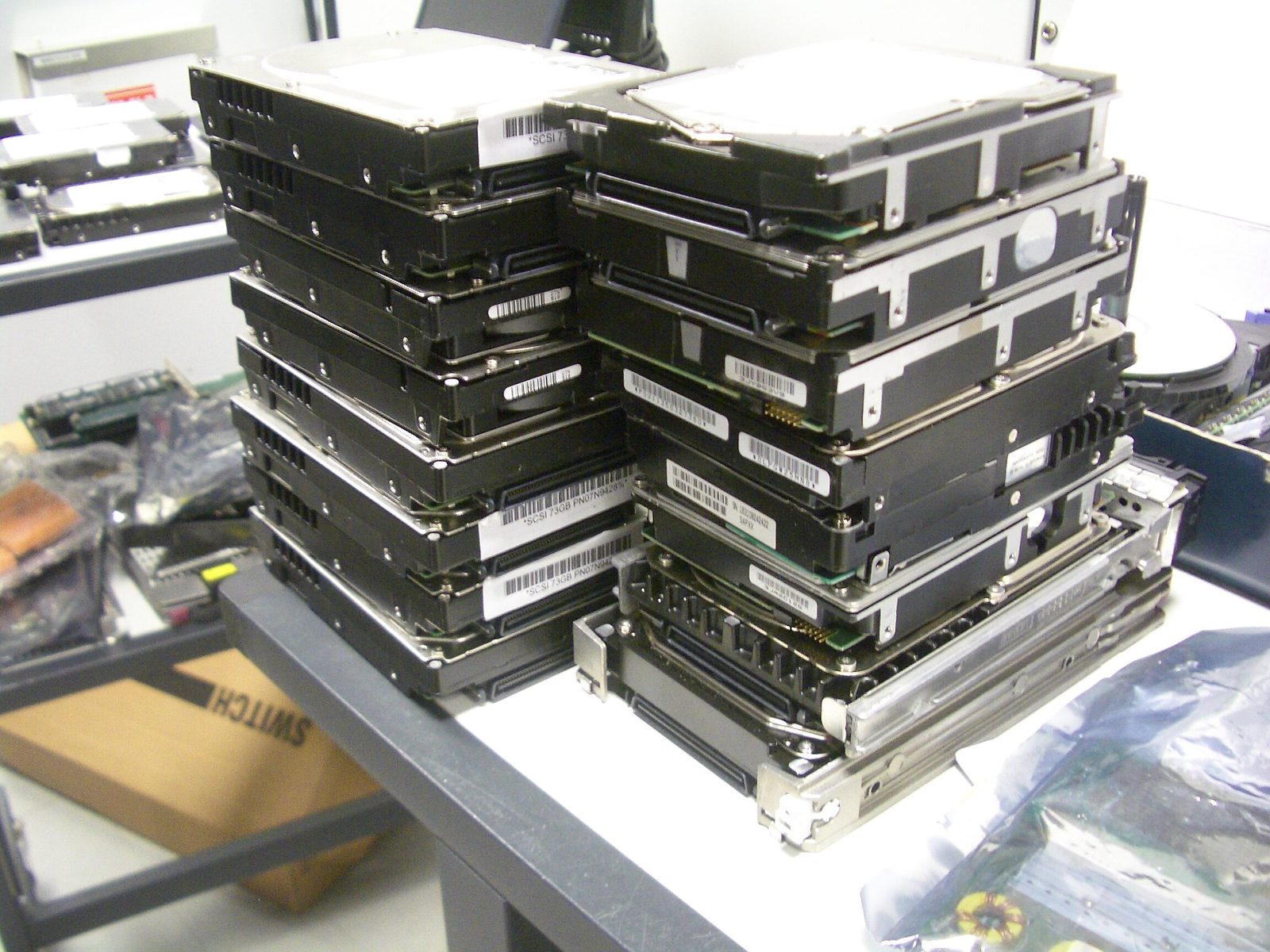
A spare does not earn its place on that shelf by arriving. Drives go onto a test bench, are low level formatted to the sector format of the array they will serve, and are stocked only once they report zero grown defects and no uncorrected read, write or verify errors. A spare that fails on the night you need it was never a spare.
Replace early, upgrade on time
Hardware here is retired on evidence, not on failure.
Drives. A drive that reports its first corrected error is drained and replaced. We do not wait to see whether it gets worse. Replacing a working drive is cheaper than rebuilding an array under load, and you never learn either word.
Firmware. A chassis fleet is brought to one firmware level before it carries anything, and kept level afterwards. Mixed firmware is the kind of problem that only introduces itself on the worst possible day.
Platforms. The systems we run the business on are kept on current security releases as routine, not as a crisis, each move with the rollback prepared before the first command and the interruption measured in minutes.
Critical vulnerabilities, the same day. When a top severity flaw is disclosed in something we depend on, we do not wait for anyone's packaging schedule. Protective configuration goes on immediately. If no fixed package exists yet for the platform we run, we build it ourselves, compiled in a clean container from the maintainer's own specification, verified against the project's published source, installed host by host with checks before and after. The last time this was needed, the fix was in production about three hours after the source was published. We run our own package mirror for the same reason.
Documentation as infrastructure
Plenty of companies have documentation. We treat it as part of the plant.
Every device we are responsible for exists as a record: its rack, its ports, its addresses, its role. Every cable carries a unique printed identifier from one register that cannot issue the same number twice and never re uses one, even after the cable is pulled. The label names both ends, rack, device and port at each. Twenty two years of cabling can still be traced from the label, to the record, to the switch port, and back.
A service is not finished when it works. It is finished when its address, its firewall rule, its inventory record and its forward and reverse DNS all exist and have been verified from outside our network.
Every change is written down before it is made, with the way back out written next to it. A network device is not reconfigured until a fresh backup of its running configuration exists. Changes go in one command at a time. A configuration that fails its own validation never takes effect: the previous one keeps running and nothing changes for anyone using the service. Our tooling refuses the command when the rule has not been met, which is a better guard than good intentions.
This is what matters at three in the morning. The question then is never what the clever fix is. It is what changed, and how do we put it back.
Certified, and audited
- ISO/IEC 27001, with the 27017 and 27018 control sets for cloud services and personal data
- ISO 9001
- ISO 14001
- ISO 37001
All four were issued in September 2026 by a nationally accredited certification body, with the scope written as "Managed datacenter hosting service". That is the service you actually buy, not a corner of the company chosen to make an audit easy. A SOC 2 programme is in progress.
Your data stays where you put it, and at our European sites that means inside the EU, on hardware we own, with no public cloud underneath it. We sign a data processing agreement, and our technical and organisational measures document is available on request.
Engineers, not tiers
No bots, and no scripted first reply.
The engineers who choose the hardware, rack it, cable it and label it are the same engineers who answer your ticket, and they sign it with their own name. That works because the people here know your configuration by name and are senior enough not to need a script.
Over the past year our median first response is six minutes, and 87 percent of tickets are answered inside the hour. A good share are opened by us rather than by you: our monitoring watches everything we are responsible for around the clock, down to your actual pages, and alarms land in a channel engineers read.
Still the same
Same founder. Same hands on the hardware. Still no investors, still no loans, still no exit plan, and still the rule we started with in a colocation hall in Amsterdam: buy the better machine.
We give escorted visits to the Athens datacenter: the cage, the fibre, the optics in their trays, the spares on the shelf. We will walk you through it ourselves, because we are the ones who built it. Bring an engineer.