

What we do · Storage and compute
Storage replication between Athens and Amsterdam
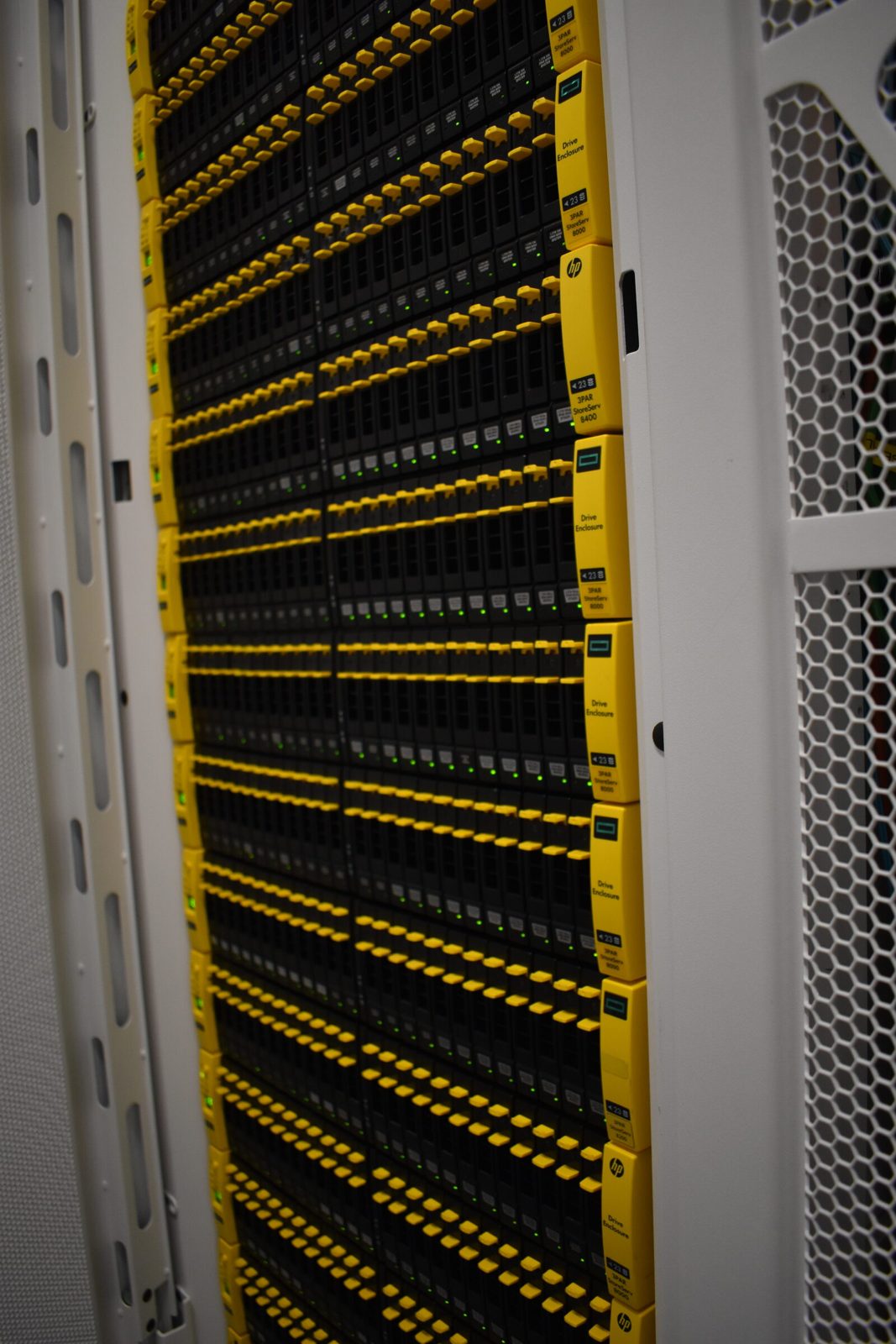
Your volumes can live on one HPE 3PAR array in Athens and be continuously copied, array to array, to another in Amsterdam. Two datacenters, two countries, one network of ours in between, and the copy never leaves our EU infrastructure. Inside each site the arrays are federated too, so your volumes move between arrays live while your servers keep running.
What it is
Array-level replication between our datacenters, available as a service. The array itself copies the blocks of your selected volumes to a partner array at the other site with HPE Remote Copy; nothing is installed on your servers.
Underneath sits federation: within a site, several arrays are joined into one storage estate, every host is zoned to every array, and volumes migrate between them online with Peer Motion. Replication protects you from losing a site; federation means our own maintenance never costs you a window.
How we build it
Athens to Amsterdam, array to array. Volumes you choose are placed in Remote Copy groups that replicate to a partner array in the other datacenter, over our own private interconnect between the sites. Related volumes, such as a database's data and log disks, sit in the same group so they stay consistent with each other.
Dedicated replication ports. Remote Copy runs over its own ports, strictly one partner per port pair, kept apart from the ports used for federation and from host traffic. Protection never competes with your I/O.
Federation inside every site. Every host is zoned to every array on both fabrics, so moving a volume between arrays is an online operation. Athens and Amsterdam are both built this way.
What it protects you from
- Losing a whole datacenter with the only copy of your data in it.
- A whole array failing inside a site.
- Storage maintenance turning into downtime for your platform.
- Replication that depends on agents inside your servers, and breaks when they do.
- Your disaster recovery copy ending up outside the EU.
- Replication traffic slowing down your production I/O.
In practice
Replicas laid out one per array. For an analytics customer migrating a clustered database, each cluster member's data volume was placed on a different physical array. Volumes are thin and presented at full size, so the design costs flash only for real data, and an array failure costs one member, not the service.
Why EuroVPS
- Array-to-array replication between two of our own datacenters, on our own interconnect.
- No agents, no software in your servers: the arrays do the copying.
- Dedicated replication ports, so protection never costs you latency.
- EU data replicated inside the EU, always.
- Data placement decided per workload by engineers, down to which array holds which replica.
FAQ
Which of my volumes are replicated to the other site? The ones you choose. We place them in Remote Copy groups and give you the list.
How current is the copy in the other site? It follows the service you order and what your application needs. We agree it with you up front, rather than quote a house number.
Do I need standby servers in the second site? For a fast failover, yes, and we can provide them. Without them, the replica still protects your data and is presented to new servers when needed.
Will moving my volume between arrays cause downtime? No. Peer Motion moves the volume online while your host keeps working.
A second copy in another country beats a restore you have to wait for. Talk to an engineer about replicating your platform between Athens and Amsterdam.
Your next infrastructure partner
Let’s look at
your setup.
Tell us what you run today and what needs to improve. An engineer will review your brief and help you plan the next step.
+357 222 32280
who will look after your infrastructure.
Let’s start with your setup.
A little context helps us start the right conversation.