

How to read a dual-fed rack's power, and what the numbers hide
Two feeds only protect you if either can carry the whole rack. How to read A and B feed draw, plan the failover load, balance phases and move cords safely.
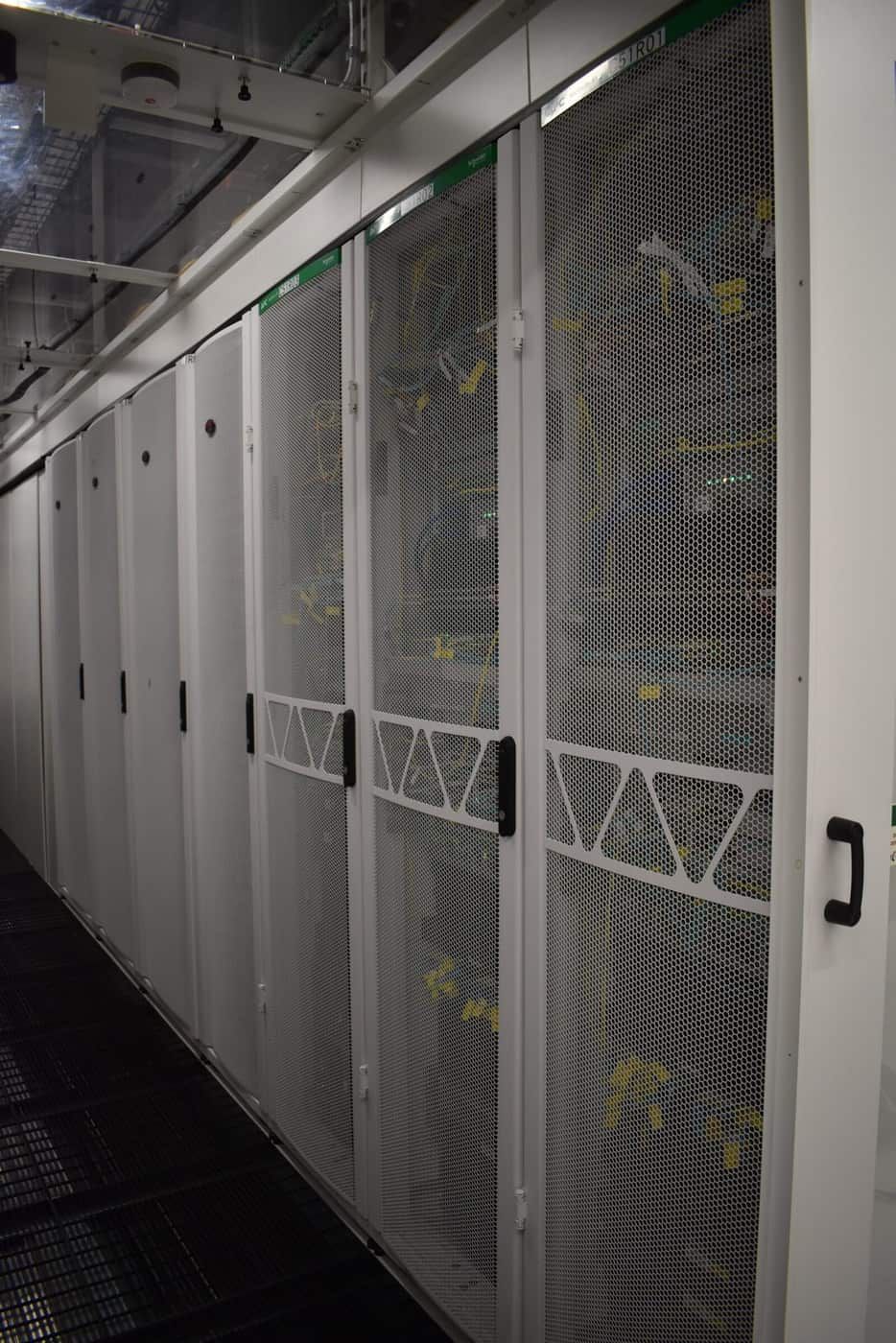
A rack with two power feeds looks redundant from the front. Two power strips, two sets of cords, two lights on every power supply. Whether it really is redundant depends on a number most people never calculate: the load one feed would carry if the other disappeared. Here is how to read a dual-fed rack properly, and the traps hidden in the readings.
The only question that matters
The only number that matters is the load one feed carries when the other is gone:
Would the sum of both feeds fit on either feed alone, with margin?
Add the A feed and the B feed together and compare the total with what a single feed can safely carry. If the total does not fit, the rack has two feeds but no redundancy. It has two ways to fail.
What "safely carry" means
The figure to compare against is not the breaker's rating. Breakers protecting circuits that run continuously are normally planned at a fraction of their rating, and a common rule of thumb is 80 percent. Your local electrical code and your datacenter's contract are the authority here, so check both, but the principle holds everywhere: plan to a limit below the trip point.
A worked example with round numbers. A rack is fed by two single-phase feeds, each protected at 16 A. Planning at 80 percent gives a usable 12.8 A per feed. The A strip reads 6.1 A and the B strip reads 5.4 A. The failover load is 11.5 A, which fits under 12.8 A, but with very little room. That rack is fine today and full for planning purposes. Add one more server and a feed loss would put the survivor above its planning limit.
Measure, do not assume, the split
It is tempting to measure one feed and double it. Do not. The split between feeds is often uneven:
- Some power supplies share load unevenly by design, or run one supply hot and the other nearly idle.
- Single-corded devices put their whole load on one feed and nothing on the other.
- A server with one failed or unplugged supply silently moves its whole load to one side.
Measure both strips, always. And watch the peaks, not just the average. A rack that fits comfortably at night may not fit during the busiest hour, or while every server spins its fans up after a firmware update. A week of minute-by-minute readings, peaks included, is a far better basis for a decision than one reading taken during a walk through the room.
Keep the planning in amps per feed and convert only for reporting.
Three phases, three separate questions
On three-phase supplies, the calculation has to be done per phase, because each phase has its own limit. Phase L1 on the A feed plus phase L1 on the B feed must fit on one feed's L1, and the same for L2 and L3. A rack can look comfortable in total while one phase sits close to its limit, and in a feed loss it is that phase that decides what happens.
Balancing is the cure. Spread load so each phase carries a similar share on both feeds. On a rack that is already in production, rebalancing is done by moving power cords of dual-corded devices, and there is a safe way to do it: move one cord of a dual-corded device at a time, after confirming both supplies are actually drawing.
Do not forget the layers above the rack
For the UPS units upstream, the readings that matter are battery temperature, state of charge, estimated runtime at the present load, and whether the unit is online or on bypass. Watch them continuously, not once a year. A battery that is ageing announces it gradually through rising temperature and falling runtime long before it fails a real load. Transfer switches deserve the same attention: every transfer between sources is an event worth an alarm and a timestamp.
How we do it
Every power strip on both feeds of every rack is polled over SNMP every minute. Every UPS and transfer switch is polled the same way, every reading and event is kept, and alarms go to the engineer on call for deep battery discharge, outlet state changes, source transfers and loss of redundancy. Engineers see the result as a live power-flow map from the utility feed to the racks and as rack elevations, and capacity decisions are made from measured draw against what each room is provisioned for.
Check your own racks
- For each rack, is A plus B below one feed's planning limit, at peak?
- Is the calculation done per phase on three-phase feeds?
- Which devices are single-corded, and which feed are they on?
- Does any server have a failed or unplugged supply right now?
- When was the UPS runtime at the current load last checked?
If you would like help reading your own power data, we are happy to look at it with you. Talk to an engineer
Published 22 October 2026.
All field notes