

What we do · Operations
A unique ID on every cable, never reused
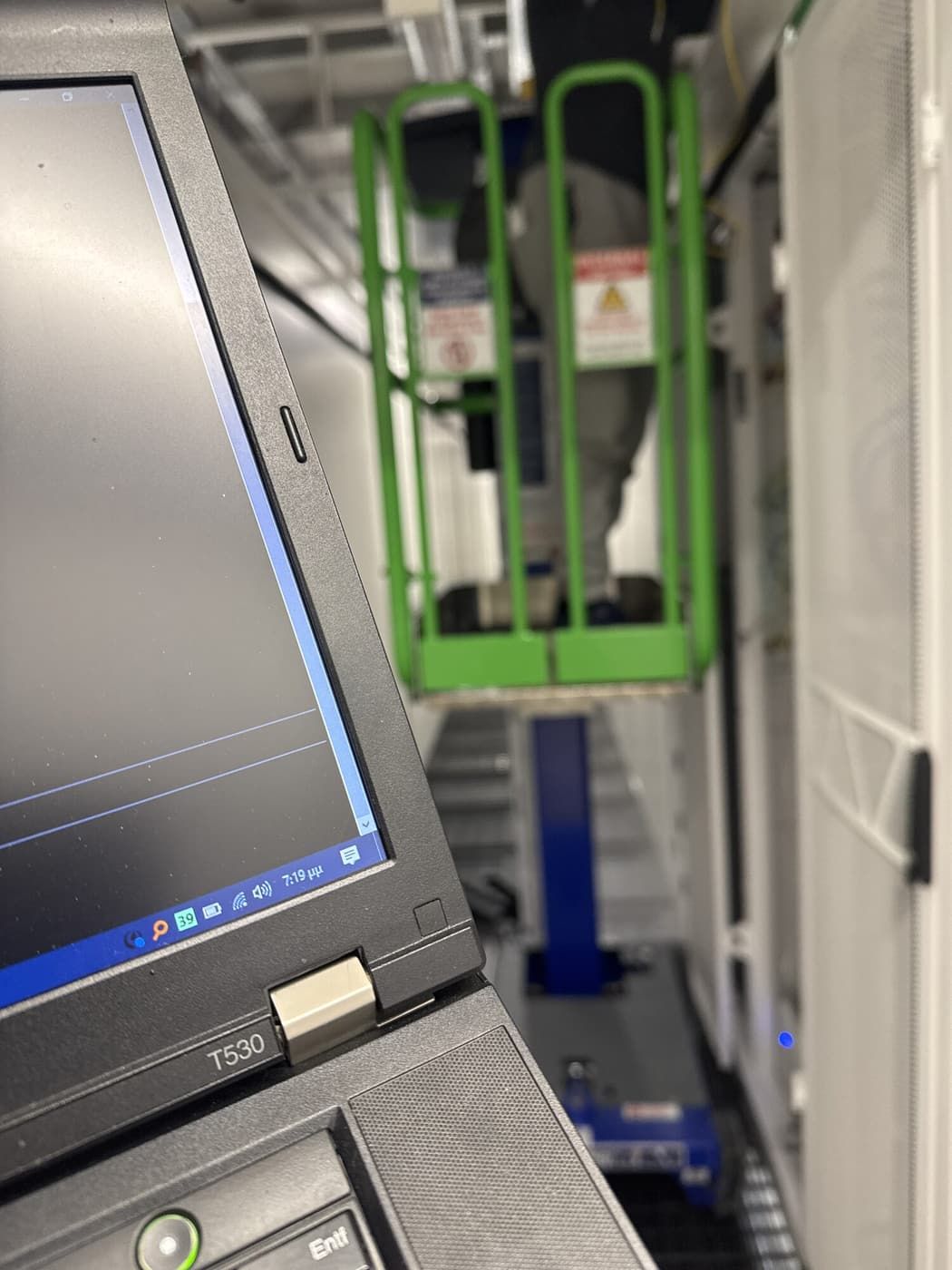
In a busy rack, the most dangerous moment is an engineer's hand on the wrong cable. We make that hard to do. Every cable we install carries a unique printed ID at both ends, the same ID is recorded on the link in our DCIM, and the number comes from an allocator that never hands it out again.
What it is
A cable ID discipline that covers every copper and fibre run we install, in every one of our datacenters:
- A unique numeric ID for every cable.
- A printed, laminated label at both ends, wrapped as a flag so it can be read from either side.
- The same ID recorded on the link in our DCIM, between the two exact ports it connects.
- An allocator that issues IDs and guarantees that no number is ever reused, not even the number of a cable that was removed years ago.
How we build it
Numbers come from one place. Nobody picks a cable ID by hand, and nobody works it out as "the highest number plus one". IDs are reserved from our allocator for a named purpose before a label is printed or a record is written. Two teams cabling at the same time draw from the same allocator, so they cannot collide.
Never reused, ever. The allocator counts every number that has ever existed: the live links in our DCIM, the links in its change history that have since been deleted, every label print job on record, and its own reservations. Allocation only moves forward. A number that was reserved and never used is voided and stays burned.
Fail-closed. Every reservation re-reads the DCIM first. If the DCIM cannot be read, nothing is issued. Our tooling refuses to record a cable ID on a link unless that ID was reserved first, and it refuses outright if the allocator cannot confirm it.
Watched all the time. A watchdog re-reads the DCIM every few minutes and alerts an engineer the moment any number appears on two links, appears without having been reserved, or reappears after being voided.
One label format, everywhere. Labels are printed on industrial label printers in a fixed two-row layout. The top row carries the cable ID with the rack, device and port at that end; the bottom row carries the far end's rack, device and port, and the cable's length.
Printed before the work starts. For a new build, the IDs are reserved and the label set is printed in advance, so cables are run, labelled and recorded against a plan that already exists.
What it protects you from
- The wrong cable pulled in your rack because two labels looked alike.
- A removed cable's number quietly reused, corrupting the record of what connects to what.
- Records and physical labels that disagree.
- Engineers tracing cables by hand while your service waits.
- Two people allocating the same number on the same day.
In practice
A new build, labelled the evening before. When new servers are planned, every link already has its reserved ID and its place in the DCIM before the hardware arrives. The labels are printed the evening before, and the servers are racked and cabled the same night against the plan.
Why EuroVPS
- A unique, printed ID at both ends of every cable we install.
- The same ID recorded on the link between the two exact ports.
- An allocator that never reuses a number, and refuses to guess.
- Continuous checks that alert an engineer on any duplicate.
- Labels printed before the work, not written up after it.
FAQ
Do the cables in my dedicated rack get labelled? Yes. Every cable we install carries a printed ID at both ends, matched to the record.
Can I get the cable list for my equipment? Yes. On request, dedicated customers get an export of their devices, ports, cables and addresses.
What happens when a cable is replaced? The new cable gets a new ID, its labels are printed and the link is updated in the DCIM. The old number is retired for good.
Why not reuse the numbers of removed cables? Because old documents, photos and tickets still mention them. A number that only ever meant one cable can never send an engineer to the wrong one.
If you want your hardware cabled by people who number every cable, Talk to an engineer.
Your next infrastructure partner
Let’s look at
your setup.
Tell us what you run today and what needs to improve. An engineer will review your brief and help you plan the next step.
+357 222 32280
who will look after your infrastructure.
Let’s start with your setup.
A little context helps us start the right conversation.