

What we do · Storage and compute
Dual-fabric Fibre Channel SAN on Brocade
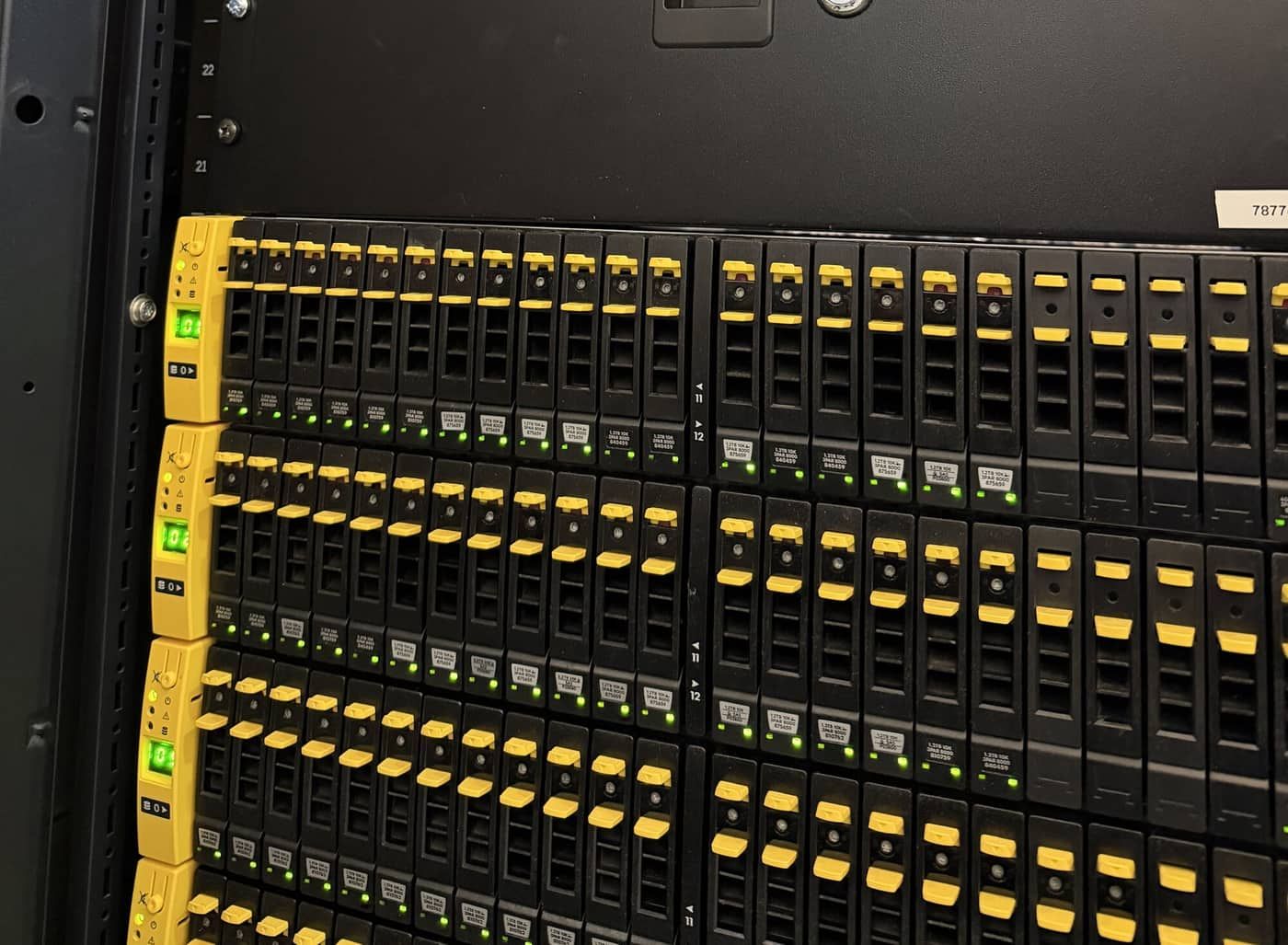
Between your servers and your storage runs a network built for one job: Fibre Channel, as two fully independent fabrics. No single switch, cable, optic or configuration change can cut a server off from its disks, because every server and every array is connected to both.
What it is
Most hosting providers carry storage over the same Ethernet that carries web traffic, or skip it entirely and keep data on local disks. We run dedicated Fibre Channel on Brocade switches, built as Fabric A and Fabric B with nothing shared between them.
How we build it
Two fabrics, nothing in common. Each site runs Brocade core switches per fabric, plus the Brocade switches embedded in our HPE c7000 blade enclosures, one per fabric per enclosure. Every host has one HBA port in Fabric A and one in Fabric B. Every array has ports in both.
One fabric at a time. Zoning changes are applied as one transaction per fabric. We enable the new configuration on one fabric, verify it, and only then touch the other, so a zoning mistake can never remove both paths at once.
New hosts in ninety seconds. A batch of new blades is zoned from a runbook in about a minute and a half of fabric change time, with no effect on the existing zones carrying production.
The inventory matches the fabric. Zoning state is mirrored into our DCIM, so what the switches say and what the inventory says can be compared at any time.
Watched for the right signals. Fabric health is monitored on frame timeouts, buffer credit behaviour and port errors, not just port up or down.
What it protects you from
- A storage switch failure taking your servers offline.
- A bad cable, optic or HBA port turning into an outage instead of a path change.
- A configuration change accidentally removing every path to your disks.
- Storage traffic competing with web traffic on a shared network.
In practice
Maintenance as a non-event. Fabric work is done one fabric at a time, with every host's paths verified before the next piece of work starts.
Why EuroVPS
- Dedicated Fibre Channel for storage, not storage traffic sharing an Ethernet network.
- Two physically separate fabrics for every host, not one switch with two cables into it.
- Changes applied to one fabric at a time, always, with verification in between.
- Every zone and port recorded in DCIM and compared against the live fabric.
- Brocade switches in our own blade enclosures, so the redundancy reaches all the way to the server.
FAQ
Do I need Fibre Channel hardware in my server? For our private cloud and SAN-booted dedicated servers, we supply it: dual-port HBAs, one port per fabric. You do not manage any of it.
Can you connect my own storage or servers to your fabrics? For colocated equipment, talk to us. Every connection follows the same dual-fabric, single-initiator design.
Why not iSCSI over Ethernet? Fibre Channel is lossless and deterministic by design, and keeping storage on its own network means a busy web day never touches your disk latency.
The fabric is the part of hosting nobody photographs. We build it like it carries everything, because it does. Talk to an engineer about your storage path.
Your next infrastructure partner
Let’s look at
your setup.
Tell us what you run today and what needs to improve. An engineer will review your brief and help you plan the next step.
+357 222 32280
who will look after your infrastructure.
Let’s start with your setup.
A little context helps us start the right conversation.