

What we do · Storage and compute
Private cloud on KVM with OLVM
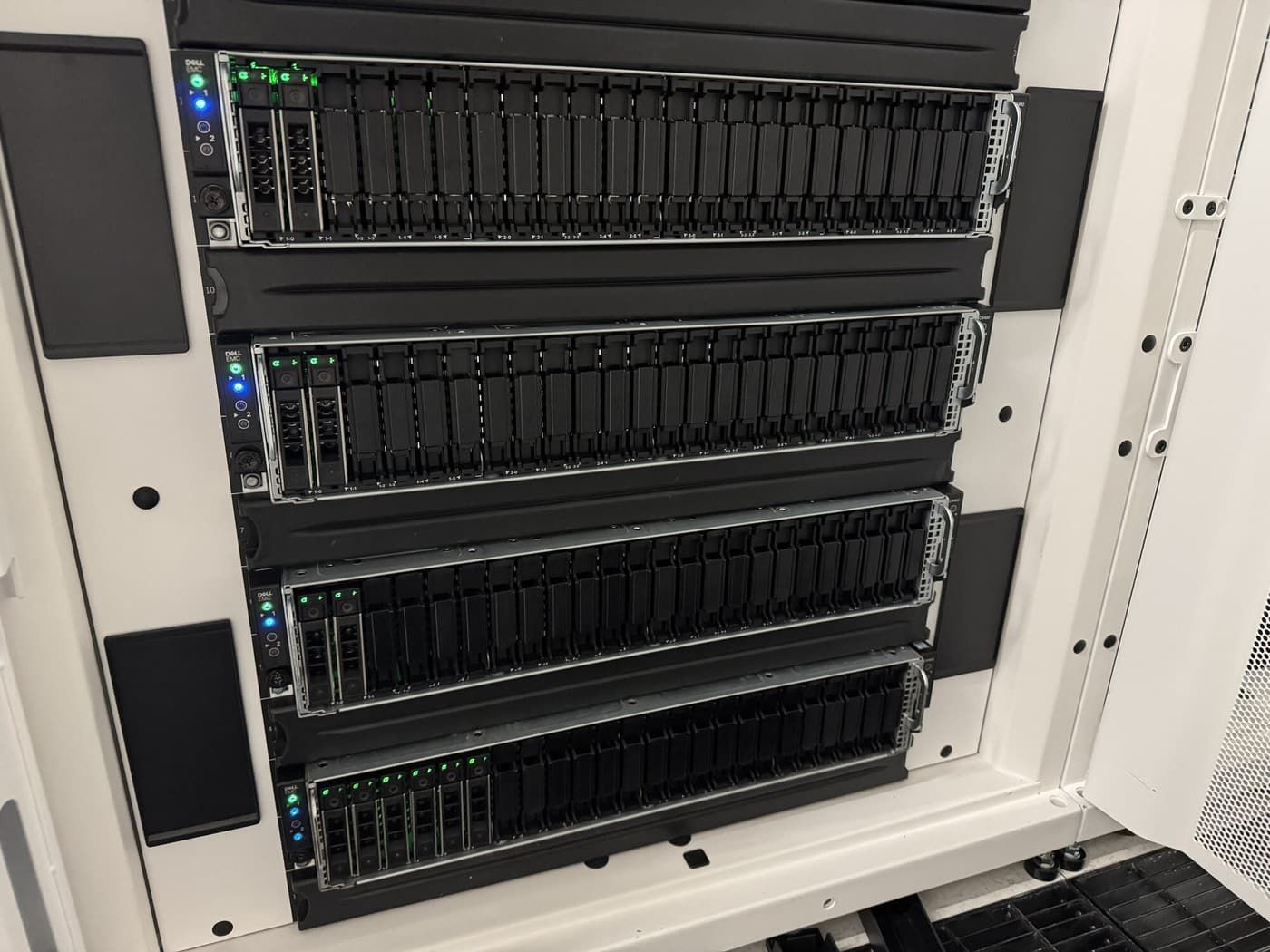
A virtualization platform of your own: KVM hypervisors managed by Oracle Linux Virtualization Manager, on HPE and Dell servers, with every virtual machine disk on our all-flash Fibre Channel SAN. Live migration, automatic restart after a host failure, full API control, and no per-core hypervisor licence bill.
What it is
OLVM is the enterprise management layer for KVM, from the oVirt lineage: clusters of hosts, shared storage domains, templates, live migration, high availability and a complete REST API. We build it as a dedicated private cloud for one customer, on single-tenant hosts if you need them, or run your VMs on our managed clusters. Either way, the hardware, the storage and the engineers are ours, in our datacenters.
How we build it
Hosts that hold nothing. Hypervisors boot from the SAN and keep every VM disk on HPE 3PAR all-flash storage, reached over two Fibre Channel fabrics with full multipathing. If a host fails, its VMs restart on another host from the same shared storage.
Storage placed by design. For clustered applications we place each member's disk on a different physical array, so a whole array can be lost without losing the service.
Built from the API, unattended. New VMs are created, given thin disks and installed from tested kickstart recipes entirely through the platform's own API.
Two sizing rules on every VM. A VM never gets more vCPU than one physical socket has cores, and never more memory than one NUMA node serves. Cross that boundary and part of every memory access goes remote at roughly 1.7 times local latency, so bigger becomes slower. And no VM gets swap: if a workload needs more memory, the answer is more memory, not your disk pretending to be RAM.
What it protects you from
- A hypervisor host failure taking your VMs down for good.
- Maintenance windows for host patching (VMs live migrate away first).
- VMs sized to look big on paper and run slower in practice.
- Per-socket or per-core hypervisor licensing that grows every renewal.
- Environments that drift because each VM was built by hand.
In practice
New hosts in production within seconds. We added three new hosts to a live production cluster. Storage was presented ahead of time, the hosts activated themselves, and the scheduler moved a running production VM onto one of them in eighteen seconds.
A complete staging estate, built unattended. For a national news publisher we built a full staging and development estate: three web properties, each with load balancer, web and database tiers, plus shared cache and search. Every VM was produced from one kickstart recipe through the OLVM API, in under an hour.
A private cloud for an analytics platform. An analytics customer runs on its own OLVM cluster of single-tenant hosts, with each database cluster member on a different array, sized inside one socket, with no swap.
Why EuroVPS
- KVM with enterprise management and no per-core hypervisor licence to renew.
- Every VM disk on all-flash SAN, every host on two fabrics.
- NUMA-correct sizing on every VM, so you get the performance you are paying for.
- Dedicated clusters available, built to your specification.
- Engineers who build the platform, run it and answer your tickets.
FAQ
Can I have my own dedicated OLVM? Yes. We build dedicated engines and clusters on single-tenant hosts.
Do I get API access? Yes. OLVM exposes a full REST API for provisioning, snapshots and lifecycle automation.
Why will you not give my VM more cores than one socket has? Because past the socket boundary the VM gets slower, not faster. We will size it to fit and tell you why.
Can you move my estate here from another hypervisor? Yes. See our migrations page: we convert and move estates with the source kept intact until the new side is proven.
A private cloud should be private, fast and yours. Talk to an engineer about building one.
Your next infrastructure partner
Let’s look at
your setup.
Tell us what you run today and what needs to improve. An engineer will review your brief and help you plan the next step.
+357 222 32280
who will look after your infrastructure.
Let’s start with your setup.
A little context helps us start the right conversation.