

What we do · Network
How we change things: network change discipline
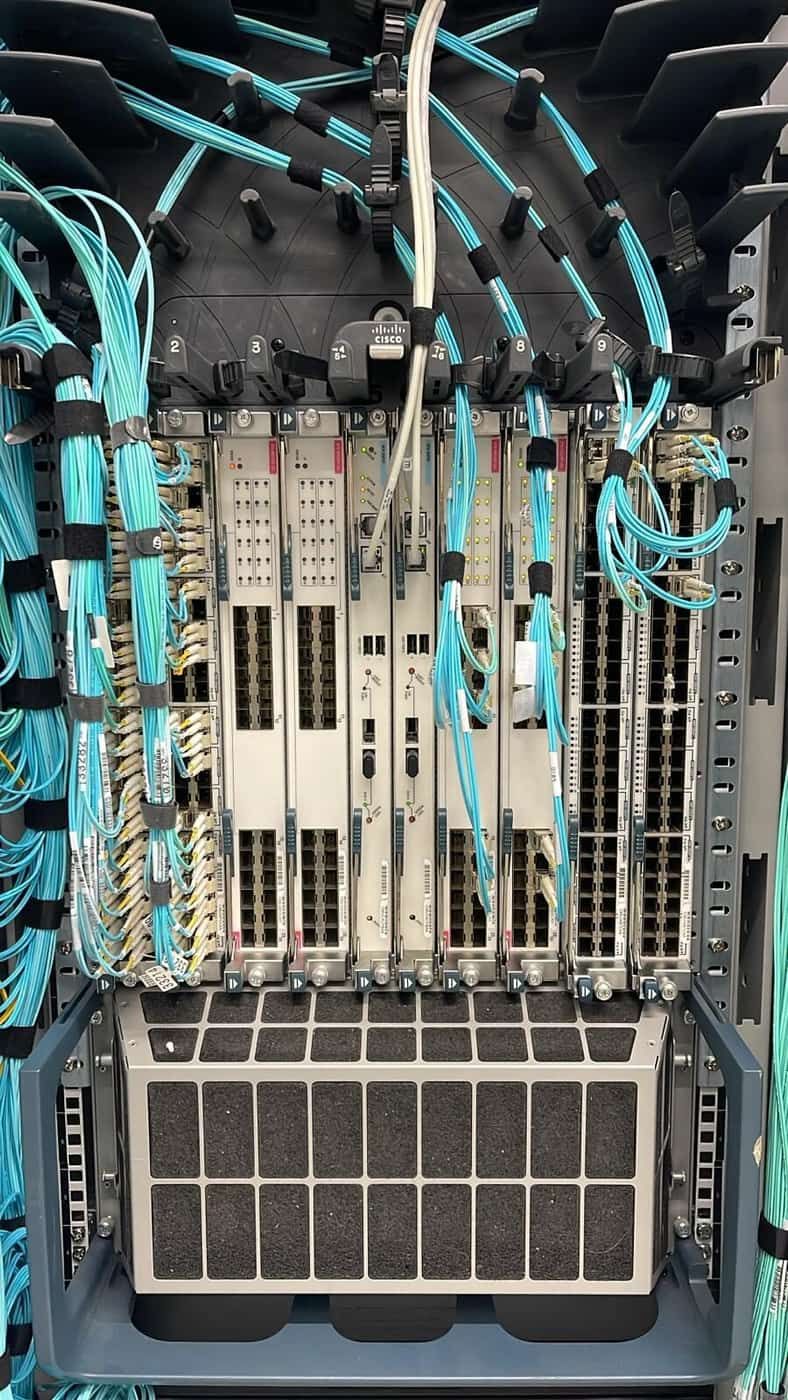
Most outages are not caused by hardware. They are caused by a change. So the way a provider changes its network matters as much as what it is built from. Every network change we make, on every platform, follows the same discipline, and it is the reason our customers rarely need to hear about our maintenance at all.
What it is
A fixed set of rules that applies to every router, switch, firewall and gateway we run, whether the change is a single VLAN or a new protocol across the whole fabric. The rules do not bend for urgency, and they do not depend on who is on shift.
How we build it
- Automatic rollback where the platform offers it. On Cisco routers we apply configuration with a revert timer, so a change that cuts off access undoes itself. Firewall migrations use scripted cutovers with a ping-gated automatic rollback. Large rollouts take automatic before and after snapshots of every routing session and roll themselves back if anything differs.
- Machines check the rules. The fabric's VLAN-to-VXLAN map is compared every hour against a cryptographically signed baseline in version control. Firewalls are configured only through their API. New customer gateways are compared against a proven reference before a single credential is issued.
- Records match reality. Every cable carries a unique printed ID at both ends, issued by a single allocator that never reuses a number, and every object we touch is updated in DCIM in the same session.
What it protects you from
- A maintenance change becoming your outage.
- A failed change with no fast way back.
- Both halves of a redundant system going down together because both were touched together.
- Drift between what the documentation says and what the network does.
- Changes that cannot be traced to a time, a reason and an author.
In practice
A protocol added across a live fabric. When we add a protocol or address family across the whole fabric, the work runs in strict batches, one device at a time, never both halves of a pair together, with automatic routing snapshots before and after each step and self-rollback within about thirty seconds if anything differs.
Firewall migrations one VLAN at a time. When a network segment moves from one firewall platform to another, the new firewall first joins routing while announcing nothing. It then takes ownership of one VLAN at a time through a scripted cutover that rolls itself back automatically if reachability checks fail.
A fabric with an audit trail. Every intended change to the fabric's segment map has to be re-signed and committed to version control. Any unplanned difference pages an engineer within the hour. Every change carries an author, a time and a reason.
Why EuroVPS
- The same written discipline on every platform, every time.
- Redundancy respected during changes, not just during failures.
- Automatic rollback wherever the platform supports it.
- Machine-enforced checks instead of good intentions.
- Documentation that is updated in the same session as the change.
FAQ
Do network changes require downtime for my service? Rarely. Most changes are made live, one half of a redundant pair at a time, so your traffic keeps flowing through the other half.
Will you tell me before a change that could affect me? Yes. If a change could touch your traffic, we agree the timing with you first.
What happens if a change goes wrong? The configuration from before the change is already saved, and on most of our platforms the rollback is automatic.
Can you show me what changed? Yes. Our changes are recorded with the exact commands, and fabric changes are versioned with an author and a time.
If you want your platform run by people who change things this carefully, talk to an engineer.
Your next infrastructure partner
Let’s look at
your setup.
Tell us what you run today and what needs to improve. An engineer will review your brief and help you plan the next step.
+357 222 32280
who will look after your infrastructure.
Let’s start with your setup.
A little context helps us start the right conversation.